
Advancing Flash Memory Performance for the Edge AI Era
June 26, 2026
Blog
As embedded systems evolve to support more powerful edge AI, real-time analytics and high-resolution video processing, flash memory storage has become a critical determinant of system performance, responsiveness and power efficiency. In the past, flash memory developments focused primarily on increasing capacity and reducing cost. Today bandwidth, latency, reliability, capacity and cost are all equally important design criteria.
This article describes how three updated specifications, MIPI M-PHY v6.0, MIPI UniPro v3.0 and JEDEC UFS 5.0 support these new design challenges. It will explain how they deliver a high-performance flash memory storage solution that addresses the growing market need for high-throughput, low-latency flash memory in embedded platforms, with use cases ranging from mobile, PC and gaming devices to automotive and industrial systems.
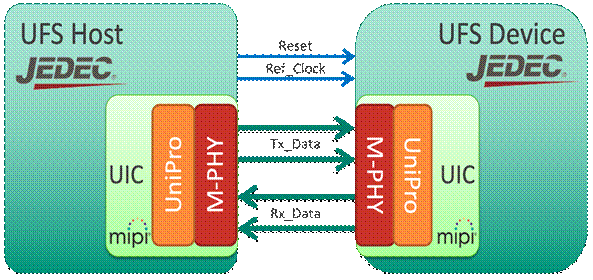
Figure 1: Use of MIPI M-PHY and MIPI UniPro within JEDEC UFS (Source: MIPI Alliance)
Faster Physical Layer Supports Double the Bandwidth
MIPI M-PHY v6.0 serves as the foundation of the updated solution, introducing a significant advancement in physical-layer performance. Adopting PAM4 signaling combined with 1b1b encoding, M-PHY v6.0 adds a new speed gear—Gear 6—which enables data rates of up to 46.6 Gbps per lane. This is double the bandwidth of the previous version of the specification while also maintaining backward compatibility.
The increase in data rate is not only about peak throughput; it enables new design trade-offs, such as the ability to reduce lane count to save pins and reduce power while maintaining the required level of bandwidth. M-PHY’s support of burst-mode operation and ultra-low-power standby states are also critical for energy-constrained designs, particularly for battery-powered systems.
The introduction of new signal integrity features is also highly beneficial. Optional link equalization and training features, together with advanced transmitter and receiver equalization schemes, will enable systems to maintain reliable high-speed operation in noisier electromagnetic environments. This is particularly advantageous with challenging designs, such as the channels required for long PCB traces or compact, high-density packages. In addition, new diagnostic capabilities like eye monitoring will help reduce system debug complexity.
A More Efficient, Reliable Link Layer
Leveraging the M-PHY physical layer, MIPI UniPro v3.0 introduces several new enhancements that improve transport and link-layer efficiency. Supporting 46.6 Gbps per lane, UniPro v3.0 aligns with M-PHY’s new high-speed data-rate, while also improving data integrity and reducing signaling overhead.
A major update is the introduction of 1b1b encoding at HS-G6 instead of 8b/10b encoding and reducing signaling overhead by approximately 20%. This is complemented by a new transport framing structure, along with Reed-Solomon forward error correction and 64-bit CRC protection, enabling extremely low bit-error rates suitable for safety-critical applications.
UniPro v3.0 also introduces several new capabilities that help optimize link management. These include faster link startup, mandatory high-speed link initialization and new streamlined power mode transitions all of which help reduce latency during system boot-up. In addition, new enhanced link training and equalization procedures will enable software-controlled optimization of signal quality, allowing device firmware to adapt to varying channel conditions during system operation.
These improvements cement UniPro’s role as a robust link layer that reduces application-layer complexity while also ensuring reliable, high-speed data transport between host and storage devices.
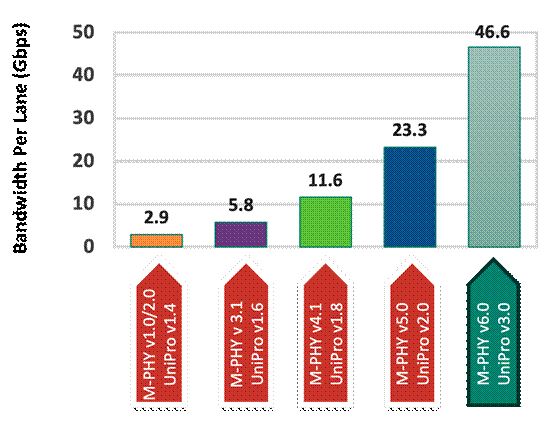
Figure 2: MIPI M-PHY and MIPI UniPro specification evolution (Source: MIPI Alliance)
UFS 5.0: Ready for the Next Generation of Flash Memory Use Cases
JEDEC’s UFS 5.0 standard leverages the numerous advancements provided in M-PHY v6.0 and UniPro v3.0 to deliver the next level of flash memory storage performance. Supporting double the interface bandwidth of UFS 4.0, UFS 5.0 enables faster read/write operations and reduced latency, delivering improved overall system responsiveness.
Beyond the raw bandwidth performance, UFS 5.0 also introduces numerous features that enhance firmware and system design. These new features include the addition of zoned storage which reduces write amplification and improves system efficiency by matching logical data placement with the underlying characteristics of flash memory. New pre-erase capabilities will allow host devices to prepare memory blocks in advance of use, minimizing write latency. And a per-command write booster control will enable fine-grained performance tuning for critical workloads.
UFS 5.0 also enhances data protection through the addition of inline hashing support in the host controller interface. This capability allows cryptographic operations to be offloaded from the CPU to the memory system, resulting in significantly reduced CPU overhead.
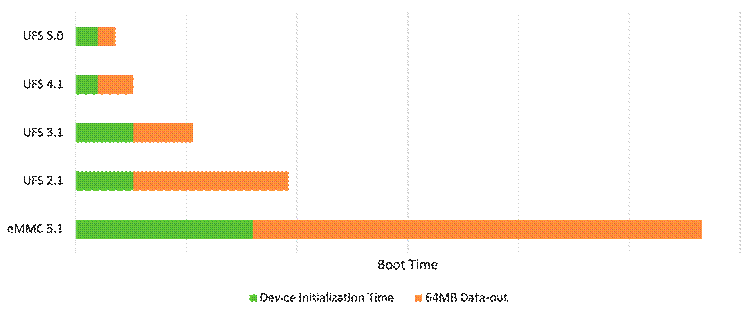
Figure 3: Faster boot from UFS due to high-speed sequential read and improved link start-up sequence (estimated, comparative timing shown) (Source: MIPI Alliance)
Enabling Edge AI and Data-Intensive Applications
A compelling use case for the adoption of UFS 5.0 is the enablement of new or enhanced edge AI capabilities. For example, the large data models used to enable vision-based AI systems often exceed available DRAM capacity, necessitating the efficient loading of these large data models from non-volatile flash storage. The faster and more efficient read/write speeds supported by UFS 5.0 support these new use cases by enabling selective data movement, where the only the necessary portions of the data model are loaded into volatile memory. These new capabilities provided by UFS 5.0 help to balance system performance, power and cost.
The release of M-PHY v6.0, UniPro v3.0, and UFS 5.0 marks the next step in the evolution of embedded flash storage. By addressing bandwidth, latency, power and reliability holistically, these specifications enable the next generation of AI-enabled embedded systems. As workloads continue to evolve, leveraging the advanced storage stack solution provided by these specifications will be essential to achieving scalable, efficient and future-ready designs.
Learn more about M-PHY v6.0, UniPro v3.0, and UFS 5.0 in the recent MIPI-JEDEC webinar “The Evolution of UFS: Leveraging M-PHY v6.0 and UniPro v3.0 for Next-Generation Performance, Power Efficiency and Reliability.”