
Analog Devices
PO Box 9106
Norwood, MA 02062 [email protected]
(781) 329-4700
https://www.analog.com/en/index.html

Analog & Power
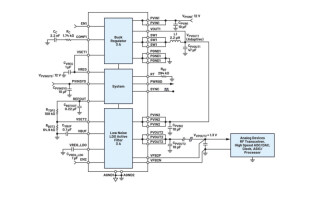
Optimizing LDO Headroom Control with a Current Referenced Switching Regulator Design—Part 1: Noise Sources, Impact, and Strategies - Blog
December 02, 2025This article explores the various sources of noise in switching regulators and their impact on different analog signal chain components. It highlights several noise mitigation strategies, including the use of low dropout (LDO) regulators as effective postregulation filters. The article also shows a range of solutions from Analog Devices (ADI) that deliver optimized LDO efficiency across varying load conditions and output voltages, while pairing good power supply noise rejection. One solution offers a new method for LDOs to control the headroom provided by switching regulators with current reference architectures.
Software & OS
Accelerating Innovation: Wi-Fi HaLow for Industrial IoT & CodeFusion Studio for AI Development - Podcast
November 05, 2025In this episode of Embedded Insiders, the VP of Sales and Business Development at Gateworks Corporation, Kelly Peralta, joins me to discuss the trends, challenges, and innovations surrounding Wi-Fi HaLow for industrial and IoT applications.
The next segment is sponsored by Analog Devices, and Contributing Editor, Rich Nass, and Analog Devices’ Senior Vice President of Software and Digital Platforms, Rob Oshan, discuss the complexity of designing AI systems and how Analog Devices’ CodeFusion Studio, which includes an IDE, a software development kit, and coding tools, is designed to accelerate the process.
Check out the embedded world North America 2025 Best-in-Show winners.
Software & OS

Embedded Executive: Get All Your AI In One Place | Analog Devices - Podcast
November 05, 2025There are lots of semiconductor vendors that do a great job of providing AI hardware. But unfortunately, for many of them, their offerings end there, requiring developers to source software and tools from multiple sources. It’s no secret that designing a system with AI is complex enough. Having to go to different vendors for different pieces just adds multiple layers of complexity.
Analog & Power
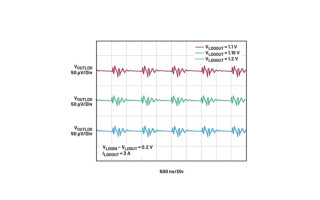
Voltage Input-to-Output Control for Linear Regulators—Part 1: Quick Start and Benefits - Story
November 03, 2025Part 1 of this two-part series introduces voltage input-to-output control (VIOC) systems that are commonly configured as a combination of low dropout (LDO) regulators with the VIOC feature and buck-topology switching regulators. The article then gives guidance for VIOC system design, including a list of suggested pairs of LDOs and switching regulators and the reasons for the pairing. Lastly, it shows how the use of the LDO’s VIOC feature can reduce noise at the LDO output, optimize power dissipation, protect the system during faults, and ensure proper operation during dynamic conditions like startup and overload. Part 2 expands on the guidance for VIOC system design from Part 1 and also discusses VIOC theory of operation and background.
AI & Machine Learning
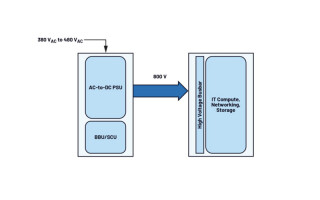
Protection and Telemetry in AI with 800 V Hot Swap - Blog
October 09, 2025This article addresses the growing power demands of AI server environments, driven by the increasing power consumption of GPUs. It highlights the shift from 48 V to 800 V power delivery architectures. This article explores Analog Devices’ continued innovation in high voltage hot swap protection as data center infrastructure evolves.
Analog & Power
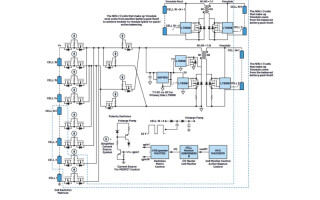
Part 2: Discovering an Efficient Active Balancing Solution for BMS Design - Blog
October 06, 2025Simplicity and efficiency are not always a difficult trade-off; excellent and successful designs often combine both. This article introduces several traditional active balancing solutions for battery management systems (BMS) and discusses how to leverage the strengths of these popular approaches to develop a more practical solution that better achieves simplicity and efficiency in design. Finally, it explains why pack-to-pack balancing is just as important as cell-to-cell balancing.
Tech News Roundup
ICYMI: Embedded Insights Ep33 Agriculture, Capacitors, Numbers, and FPGA! - Video
September 19, 2025Hello Embedded Engineers, Developers and Professionals! Welcome to In Case You Missed it: Embedded Insights, the weekly news show all about Embedded technologies and solutions from Embedded Computing Design.