
Analog Devices
PO Box 9106
Norwood, MA 02062 [email protected]
(781) 329-4700
https://www.analog.com/en/index.html

Healthcare

Enhancing Medical Visualization and Display Connectivity—Part 1: GMSL Technology - Blog
July 09, 2026The growing demand for high-resolution cameras and displays in surgical and acute care settings is driven by the need for greater visual precision, enabling clinicians to make faster, more accurate decisions during procedures. These technologies are also being designed with clinician comfort and usability in mind, reducing fatigue during lengthy surgeries and ensuring seamless integration into daily practice. This article is the first in a series exploring technologies for medical visualization and display connectivity, with each installment focusing on key innovations that enhance image quality, system integration, and patient safety. Analog Devices’ Gigabit Multimedia Serial Link™ (GMSL) technology addresses this need by enabling transmission of uncompressed video, control signals, and power over a single cable, simplifying system design and improving reliability. This article explores the application of GMSL in endoscopic imaging, surgical displays, and patient care equipment, highlighting its benefits in bandwidth, power efficiency, and integration.
Debug & Test

Using Safety Application Notes to Aid Safety Designs—Part 3: Improving Functional Safety Performance - Blog
May 11, 2026After doing a first iteration of the failure modes, effects, and diagnostics analysis (FMEDA) on a safety function’s circuit, there can only be two outcomes. The first is that the system integrity level (SIL) requirements are achieved, and the second is a failure to meet the requirements.
Security

Using Safety Application Notes to Aid Safety Designs Part 2: Plugging in the FMEDA - Blog
April 28, 2026After doing some sanity checks to confirm whether the assumptions in deriving the component’s functional safety (FS) failure rate, failure mode distribution (FMD), and pin failure modes and effects analysis (FMEA), the next step system integrators need to take is to plug the data into their system’s failure modes, effects, and diagnostics analysis (FMEDA).
Debug & Test
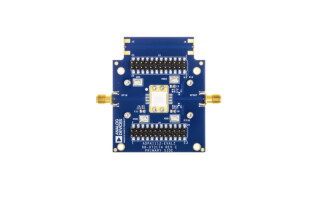
Mouser Product of the Week: Analog Devices’ ADPA1112-EVALZ Evaluation Board - Story
April 06, 2026Test and evaluation are critical and repetitive processes for engineers working with a wide variety of applications, especially those that are safety-critical. Development and test platforms are designed to support engineers developing these systems, providing ready-to-use and fully equipped solutions that measure and support the reuse or adaptation of designs to fit existing systems.
HPC/Datacenters
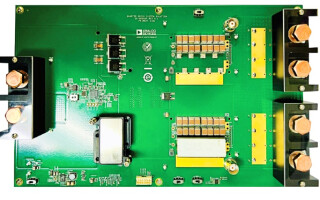
PSM Integration for Enhanced Module Solutions in 48 V Data Centers - Blog
March 04, 2026In modern data center power architectures, a quarter brick (QB) solution plays a critical role by converting intermediate bus voltages to regulated outputs that power advanced processors. To meet stringent performance and reliability requirements, integrating a digital power system manager (PSM) has become essential.
Debug & Test
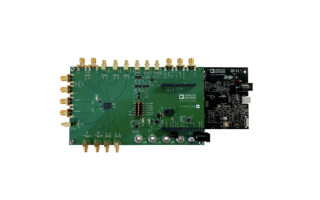
Mouser Product of the Week: Analog Devices’ EV-ADF4030SD1Z Evaluation Board - Story
March 02, 2026Evaluating, testing, and prototyping are critical and widely recognized processes in the development of various applications. Applications such as 5G timing transport, high-precision synchronization, automatic test equipment (ATE) pin electronics, and phased array radar applications can benefit from evaluation boards combining both hardware and software for testing.
Analog & Power
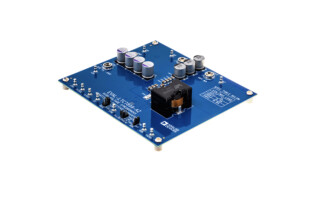
Mouser Product of the Week: Analog Devices’ EVAL-LTC7899-AZ Evaluation Board - Story
January 12, 2026Engineers test, prototype, and evaluate high-voltage power solutions to ensure they operate safely and reliably in systems like automotive, military/avionics, industrial, telecommunications, and distributed power applications. An evaluation board is designed to support the engineer, corroborating that these systems behave efficiently and predictably in real-world conditions.