
Nanopower Announces Volume Production of nPZero Power-Saving IC
March 16, 2026
News
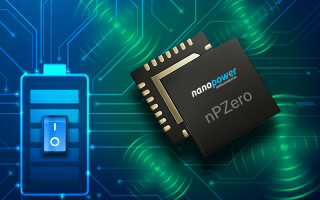
Nanopower Semiconductor's nPZero power-saving integrated circuit (PSIC) is now in volume production, enabling original equipment manufacturers (OEMs) to move from evaluation to high-volume deployment in power-constrained Internet of Things (IoT) products.
Nanopower’s nPZero is a power-saving integrated circuit (PSIC) designed to reduce the energy consumption of battery-powered applications by up to 90%. Samples and development kits are immediately available.
At Embedded World in Nuremberg, Nanopower Semiconductor displayed its nPZero in action and discussed design-in options and evaluation hardware. Nanopower showcased demonstrations focused on battery-powered and energy-harvesting, helping embedded engineers extend operating life and reduce maintenance by keeping the microcontroller in deep sleep for longer periods.
nPZero is a power-saving IC that enables always-on monitoring and control of sensors with the host microcontroller powered down. In operation, nPZero powers down the microcontroller, takes over the controller role, and autonomously handles power-up, configuration, and data reading from up to four sensors or other peripherals. The host is powered up, and control is returned when triggered by user-defined rules, allowing it to remain off for long periods while the system continues to detect and respond to events.
nPZero is designed for battery-powered and energy-harvesting IoT devices where energy budgets limit sensing frequency, uptime, or maintenance intervals. Typical deployments include smart buildings, smart cities, and smart agriculture, as well as tracking, logging, and monitoring applications where devices must remain in the field for long periods and respond reliably to threshold events.
According to the company, the nPZero has been empirically shown to significantly reduce current consumption for peripheral polling compared to a baseline system without nPZero. The measured system included a wireless microcontroller development kit plus a temperature sensor and a three-axis accelerometer.
nPZero is designed to change the system-level power profile by moving routine sensing and decision-making into an ultra-low-power companion IC, so products can remain responsive to real-world events without repeatedly waking the host processor.
To support fast evaluation and design-in, Nanopower provides access to the nPZero Configurator, which enables developers to adjust settings through a graphical user interface and automatically generate the necessary application programming interface (API) code, reducing manual bring-up effort.
For more information and technical resources, visit the company website.
About Nanopower Semiconductor
Nanopower was founded based on the invention of the ultra-low-power nPZero technology in 2017 and has developed nPZero to create a scalable solution for high-volume IoT markets. The company is incorporated in Norway, with operations and offices in Kristiansand, Norway, and Porto, Portugal.

Tiera Oliver is the assistant managing editor at Embedded Computing Design. She is responsible for web content editing, product news, and story development. She also manages, edits, and develops content for ECD podcasts, including Embedded Insiders.
She utilizes her expertise in journalism and content management to oversee editorial content, coordinate with editors, and ensure high-quality output across web, print, and multimedia platforms. She manages diverse projects, assists in the production of digital magazines, and hosts company podcasts by conducting in-depth interviews with industry leaders to deliver engaging and insightful discussions.
Tiera attended Northern Arizona University, where she received her bachelor's in journalism and political science. She was also a news reporter for the student-led newspaper, The Lumberjack.