PLS to Unveil UDE 2026 Universal Debug Engine at embedded world Germany 2026
January 21, 2026
News
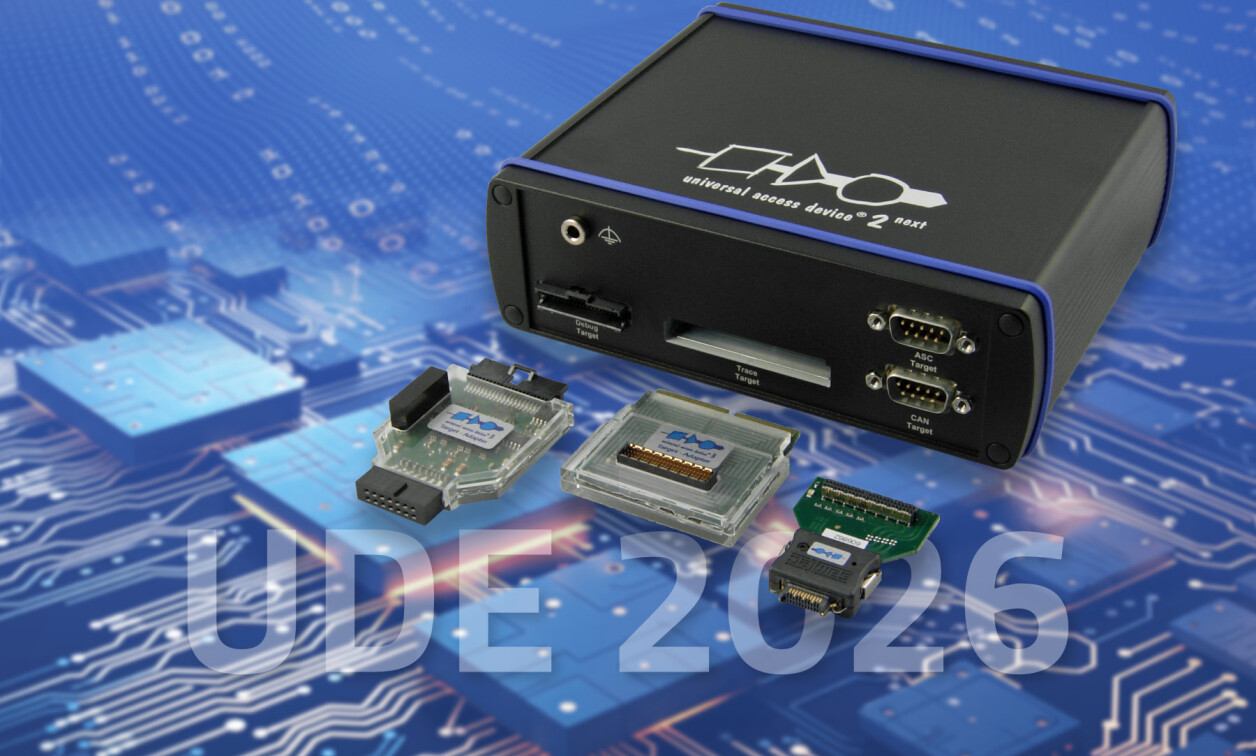
embedded world Germany 2026 will have PLS Programmierbare Logik & Systeme unveiling the UDE 2026 of the Universal Debug Engine in Hall 4, Booth 4-310. Also on exhibition will be an expanded collection of supported high-end microcontrollers and embedded processors.
Designed as a straightforward and highly efficient tool for debugging, tracing, and testing embedded software on microcontrollers and embedded processors, the CPU’s operations has been expanded for the runtime analysis of RTOS and AUTOSAR-based applications.
Currently, data collected can be determined not only by the trace system of the individual microcontroller, but also by sampling using the debug interface offering slightly lower statistical accuracy while delivering a substantial advantage by allowing the assessment of CPU utilization for MCUs lacking trace support.
Per the press release, additional operating system hooks defined in the AUTOSAR Runtime Interfaces (ARTI) permit a comprehensive visualization of the runtime behavior of AUTOSAR applications. UDE uses the display service calls and spinlocks in addition to tasks and interrupts in the execution sequence chart facilitating a more precise analysis of application and operating system behavior, making it easier to recognize any performance issues.
PLS's UDE 2026 offers its own script debugger within the integrated Python console enabling breakpoints and single-stepping in Python code, along with the display of Python variables within a dedicated watch window.
Unique developments and modifications were made to the UDE 2026 for individual MCU families and devices such as the Infineon AURIX TC4Dx. An example is the extension of trace support utilized to monitor the runtime of virtualized applications, which allows virtual machines managed by the TC4x hardware hypervisor to be visible in the trace records.
To offer trace recording during both the development phase using emulation devices and, in the field, using standard MCUs, UDE 2026 now supports trace functions for so-called production devices. However, due to device limitations, trace functionality is regulated in terms of the available trace memory size and only permits a single trace recording after a restart or reset of the application controller.
For the AURIX TC3xx -based TTControl control units of the TTC 2300 and TTC 2030 series, PLS's UDE 2026 supports preconfigured target configurations that offer a user-friendly debug environment without requiring designers to create ECU-specific configurations beforehand.
According to the company, a focus is on controllers based on Arm Cortex cores, including the S32K5 automotive MCUs from NXP, the STM32H5 MCU from STMicroelectronics, the MSPM0 and MSPM33 mixed-signal industrial microcontrollers from Texas Instruments, the latest MCU generation of the Infineon MOTIX family, and the multi-core automotive MCUs of the THA6 Gen2 series from Chinese chip manufacturer Tongxin Micro. For RISC-V, PLS supports the AndesStar V5 32-bit architecture from Andes. The first users are already using UDE for software development on the AndesCore D23 core based on it.
The full launch of UDE 2026 is projected for May 2026.
For more information, visit http://www.pls-mc.com/
Learn about all the latest news and articles about embedded world.
Secure your free ticket, click here.
Exhibiting at embedded world? Download our Marketer's Guide to embedded world.

Chad Cox is the Production Editor at Embedded Computing Design. His responsibilities are centered around content creation, writing and editing, and article research and development. Chad covers industry news and events and is known to interact with various industrial leaders via on-premise visits and online interviews. He is responsible for the digital footprint and dissemination of news via social media posts, advertising creation and the production of newsletters including the Embedded Computing Design’s Daily.
He is well versed in many facets of industrial computing including Edge AI, IoT, Processing, Security, Open Source, and more.
Chad graduated from the University of Cincinnati with a B.A. in Cultural and Analytical Literature and holds a master’s in education.