Application Highlight: ASUS PE1103N Powers Real-Time Intelligent Tourism Experiences
June 15, 2026
Sponsored Story

As the tourism boom continues, scenic destinations continue to attract a steady stream of visitors – with popular attractions often packed and bustling. To help guests get around, many sites operate sightseeing shuttles. However, traditional shuttles rely on human drivers. In crowded environments with complex park roads, drivers inevitably face safety risks such as fatigue, obstructed visibility, and delayed responses to sudden incidents – factors that not only compromise safety but can also detract from the visitor experience.
Against this backdrop, autonomous sightseeing shuttles have emerged. Powered by advanced perception systems, high-precision positioning, and intelligent decision-making algorithms, they enable smooth autonomous driving across diverse conditions, around the clock. Visitors can stay fully immersed in the scenery without worrying about driving safety. With both safety and experience improved, autonomous sightseeing shuttles are becoming an essential mobile service platform for smart scenic destinations.
Core Perception Challenge: Millisecond-Level Spatiotemporal Synchronization & Fusion of Multi-Sensor Data
In scenarios such as sightseeing parks, pedestrian trails, and closed campuses, autonomous shuttles are not operating on simple, structured roads—they must navigate highly dynamic, unstructured environments filled with uncertainty. During operation, the system must respond in real time to sudden events: children running across the path, tourists stopping for photos, or pedestrians abruptly changing direction. At the same time, the vehicle must adapt to rolling slopes, narrow winding passing sections, and road conditions that change continuously with seasons, weather conditions, and crowd flow
Even with a multi-sensor suite – including optical cameras, LiDAR, millimeter-wave radar, and an inertial-measurement unit (IMU) – precise time synchronization and spatial alignment across sensor streams remains a key bottleneck. Without millisecond-level synchronized acquisition and fusion under a unified time base, the system may suffer from perception latency, inconsistent environment modeling, and conflicting decisions. In mild cases, this leads to sluggish reactions and jerky driving; in severe cases, it can cause misjudgments, failed obstacle avoidance, and safety risks – directly impacting reliability and passenger comfort.
Edge AI Breaks Through Operational Bottlenecks for Autonomous Scenic Shuttles
To tackle complex real-world operational challenges, ASUS partnered with Lvtong Technology, a leading new-energy electric vehicle manufacturer, to deeply integrate the high-performance ASUS PE1103N edge AI computer into Lvtong’s autonomous sightseeing shuttle platform. This co-innovation systematically addresses three core challenges unexpected pedestrian interactions, complex road adaptability, and multi-vehicle coordinated dispatch – upgrading scenic transportation into a smarter, faster-response mobility system and resolving efficiency and safety bottlenecks inherent to traditional operations.
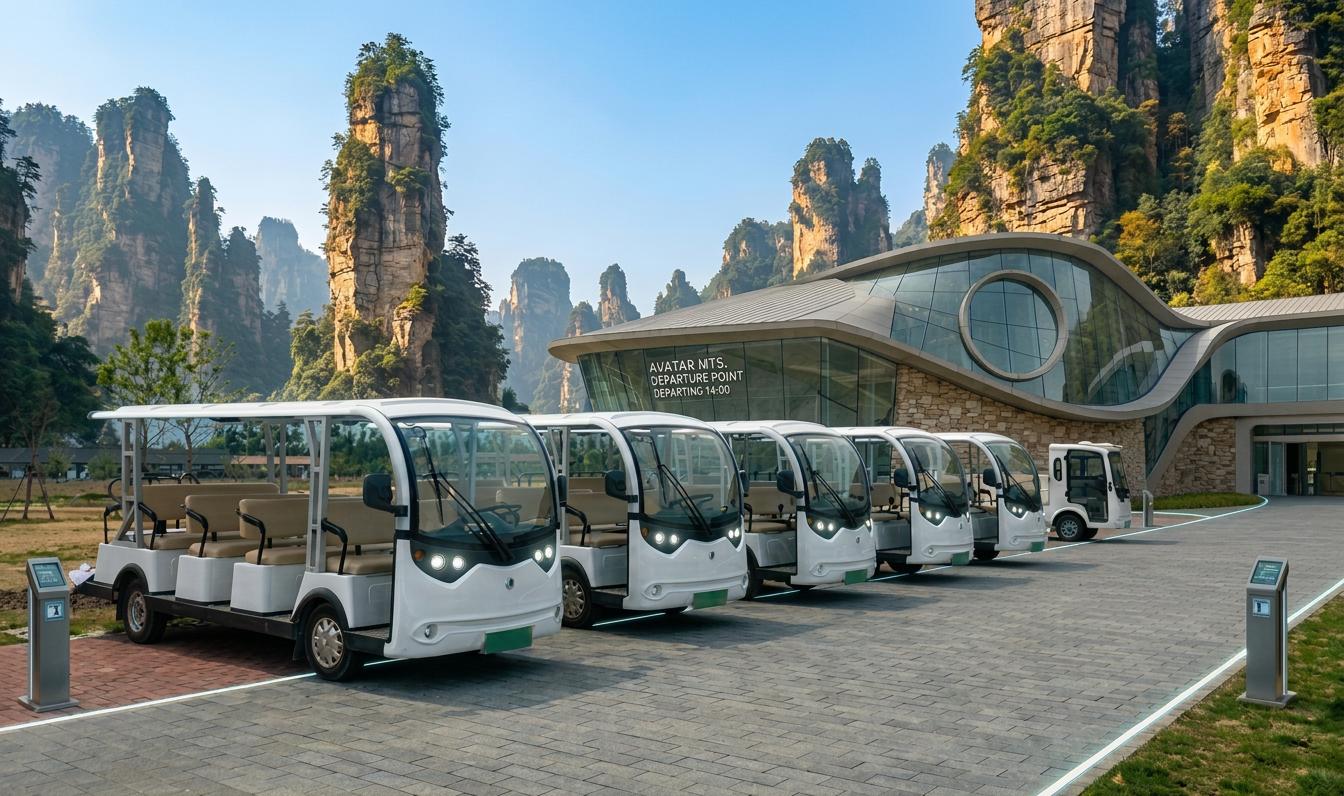
(Image Caption: Lvtong Technology Intelligent Sightseeing Shuttle)
Scenario 1: Sudden Pedestrian Occlusion – Millisecond Response with Smooth Avoidance
- Pain point: LiDAR may detect moving points first, while camera frames arrive slightly later. The system needs time to correlate signals, which can trigger harsh emergency braking at close range – causing passenger discomfort and safety concerns – startling passengers.
- ASUS advantage: LiDAR 3D point clouds, camera-based human recognition, and millimeter-wave radar velocity data are fused under the same timestamp. PE1103N can quickly and accurately identify a pedestrian, then perform real-time, smooth deceleration or avoidance – balancing safety and comfort.
Scenario 2: Slopes & Bumpy Roads – Adaptive Suspension and Attitude Control for Stable Travel
- Pain point: On rough roads or slopes, vehicle attitude changes frequently. If sensor data is not time-synchronized, the system may mistake normal vehicle vibrations for changes in the road or obstacles ahead, resulting in unnecessary hard braking, speed oscillation, or small left-right path corrections. For passengers, these extra movements can intensify motion sickness and reduce overall ride satisfaction.
- ASUS advantage: With precise time synchronization, ASUS PE1103N aligns IMU attitude data with LiDAR point clouds in real time. The system can clearly distinguish true external changes from vibration-induced perception noise and automatically filter errors caused by bumps. The result is smoother acceleration/braking and trajectory control – reducing abrupt stops and unnecessary corrections, and delivering a steadier, more comfortable ride on slopes and uneven sections.
Scenario 3: Narrow Mixed-Traffic Passing – Cooperative Perception & Precise Trajectory Planning
- Pain point: Synchronization offsets reduce multi-target trajectory prediction accuracy, causing decision delays – hesitating when it should proceed and reacting too late when it should yield – potentially leading to localized congestion or safety risks.
- ASUS advantage: With accurate synchronization, the system can build more precise motion trajectories for multiple targets simultaneously, improving next-second position prediction confidence and enabling smoother path planning – delivering passing and maneuvering performance that mimics that of an experienced driver.
Integrated Perception–Decision–Control System for Confident Handling of Complex Scenarios
By deploying the ASUS PE1103N, powered by the NVIDIA® Jetson Orin™ platform, as the onboard AI computing core up to 157 TOPS, Lvtong fully leverages Jetson Orin’s outstanding AI performance and high-efficiency multi-sensor processing designed for autonomous machines. This enables precise timestamp synchronization and real-time sensor fusion – empowering autonomous sightseeing shuttles to make intelligent decisions within milliseconds, often beyond typical human driving response levels. Even in dense crowds, irregular terrain, and complex traffic interactions, the system delivers safer and more comfortable rides – ushering in a new era of real-time edge autonomous mobility.
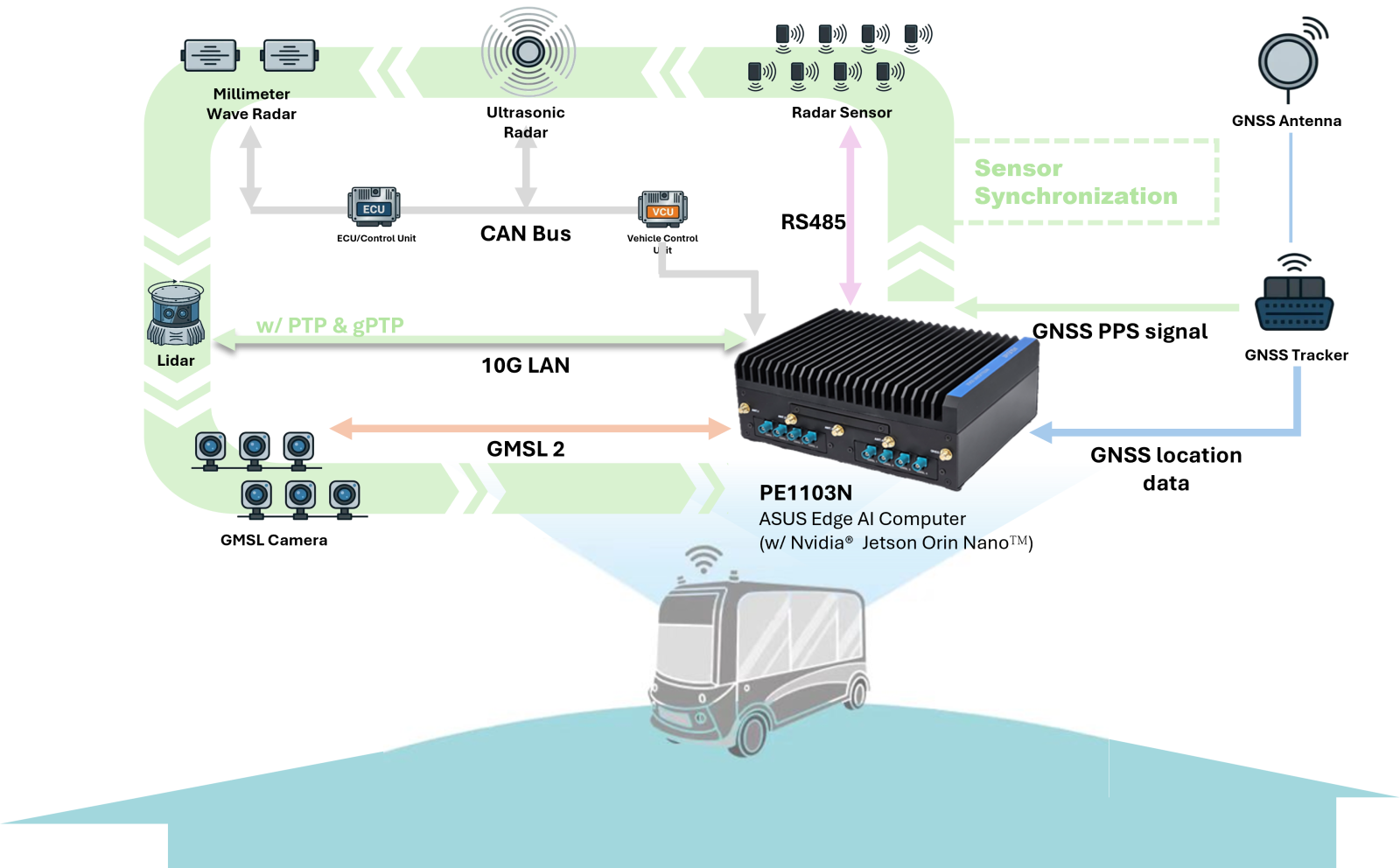
(Image Caption: ASUS PE1103N System Diagram for Autonomous Sightseeing Shuttles)
Edge Computing: Instant Response & Intelligent Dispatch
- Processes LiDAR, radar, and multi-camera data locally to achieve millisecond-level obstacle detection and navigation – without relying on the cloud.
- Dynamically optimizes routes and schedules based on real-time passenger flow and traffic conditions to maximize vehicle utilization.
- Maintains autonomous operation even with poor connectivity or complete network loss, ensuring uninterrupted service continuity.
Industrial-Grade Hardware for All-Weather Reliability
- Fanless design supports stable operation across a wide temperature range of -20°C to 60°C, suitable for diverse climates.
- Certified to MIL-STD-810H, providing shock and vibration resistance to ensure durability on rugged scenic routes.
- Intelligent power management protects the system against voltage fluctuations during vehicle ignition.
Seamless Integration for Immersive Journeys
- Supports up to eight GMSL2 cameras, enabling comprehensive situational awareness for enhanced safety.
- Built-in CAN bus and rich I/O interfaces allow seamless integration with vehicle control systems, interactive displays, and various sensors – turning ride time into an engaging part of the visitor journey.
Edge AI Powers the Future of Smart Tourism
Autonomous shuttle services are redefining modern tourism with unprecedented convenience and safety – opening a new chapter for smart sightseeing. Powered by the NVIDIA Jetson Orin high-performance computing platform, ASUS PE1103N delivers millisecond-level multi-sensor data processing to ensure accurate perception and safe operation in complex scenic environments. Its rugged industrial-grade design ensures stable reliability while significantly reducing operational and maintenance costs. Rich I/O and flexible expandability enable diverse device integration and smarter decision-making.
Through precise crowd and obstacle recognition, it provides visitors with a worry-free ride experience. PE1103N not only raises safety and efficiency standards for scenic operators but also strengthens next-generation smart tourism infrastructure by elevating the overall visitor experience, enabling operators to enhance safety while reducing labor dependency and improving operational efficiency.
Additional Resources:
Product Page: https://www.asus.com/networking-iot-servers/aiot-industrial-solutions/embedded-computers-edge-ai-systems/pe1103n/