
Using Safety Application Notes to Aid Safety Designs—Part 4: Via FS-Enabled Components
July 14, 2026
News

This last part of the series aims to introduce the benefits of using Analog Devices’ functional safety (FS)-enabled components in safety-critical applications such as those complying with industrial functional safety standards.
What Is an FS-Enabled Component?
Among Analog Devices’ four types of component offerings in its industrial functional safety (FS) portfolio, as shown in Table 1, FS-enabled parts refer to standard integrated circuits (ICs) or products not having any compliance with any functional safety standards that are recommended by ADI for functional safety use due to the functions and features,1 extensive-use experience, and available FS documentation through safety application notes.
Despite not having component-level compliance with any functional safety standard, system integrators can still use such components when designing safety-related systems and have compliance with functional safety standards—for example, IEC 61508 and ISO 13849—by following a system-level approach.5 Aside from the safety analysis critical information like reliability predictions, failure mode distribution (FMD), and pin FMEAs, ADI’s safety application notes give details of the development process that follows, typically, the ISO 9001:2015 Quality Management Standard. This information can be found in the last part of the overview section of the safety application note and typically after the functional block diagram as shown in Figure 1.
Table 1. ADI’s Industrial Functional Safety Release Types.2,3,4
|
FS Category1 |
FS Enabled |
FS Evaluated |
FS Compliant |
FS Certified |
|
Functional Safety Capability |
Enables FS at System Level |
Compliant at Device Level |
||
|
ADI quality management |
• |
• |
• |
• |
|
Reliability predictions |
• |
• |
• |
• |
|
Failure mode distribution |
• |
• |
• |
• |
|
Pin failure modes and effects analysis (FMEA) |
• |
• |
• |
• |
|
Failure modes, effects, and diagnostics analysis (FMEDA) |
|
• |
• |
• |
|
Safety data sheet |
|
• |
|
|
|
Safety manual |
|
|
• |
• |
|
External certification |
|
|
|
• |
How to Find FS-Enabled Components
FS-enabled components can be seen in Analog Devices’ Parametric Search Table when the functional safety column is added. This is done by clicking the Manage Column button and toggling the Functional Safety tag to enable FS tagging. Figure 2a to Figure 2c show this procedure.3
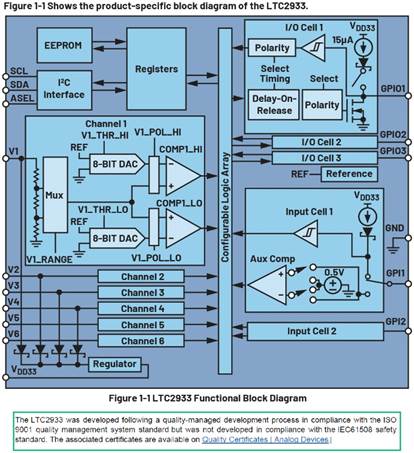
Figure 1. LTC2933’s compliance with ISO 9001 as shown in its Safety Application Note.
A robust quality management system, such as one certified under ISO 9001:2015, is essential for meeting systematic safety integrity requirements due to its significant overlap with IEC 61508. Consequently, leveraging this certification alongside a tailored functional safety strategy can streamline the overall compliance and certification process.6
What Is Extensive-Use Experience?
Field experience is one of the recommended techniques and measures to avoid faults during electrical/electronic/ programmable electronic system integration and safety validation as shown in IEC 61508-2:2010 Table B.3 and B.5, respectively. It refers to the use of components or subsystems, which have been shown by experience to have no, or only unimportant, faults when used, essentially unchanged, over a sufficient period in numerous different applications. According to IEC 61508-2:2010 Table B.6, field experience requirements can range from low effort to high effort. High effort requires 10 million hours of operation time, at least two years of experience with at least 10 devices in different applications, while low effort requires 10 thousand hours of operation time, at least one year of experience with at least 10 devices in different applications. Extensive-use experience is one of the qualifications of ADI’s FS-enabled components.6, 7
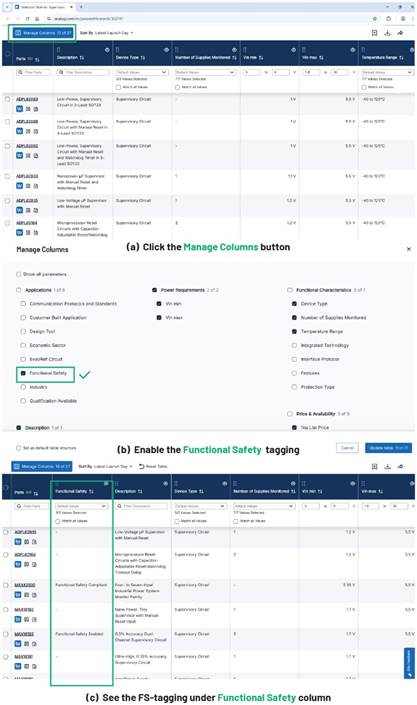
Figure 2. Enabling the functional safety column in the parametric search table.
In cases where a certain non-functional safety compliant IC is not tagged as FS-enabled and system integrators want a safety application note for such a component, they can reach out to ADI for support.
Conclusion
In summary, ADI’s FS-enabled parts provide a robust and practical pathway for system integrators to achieve system-level functional safety compliance, even without component-level certification. By leveraging extensive field-use experience and a comprehensive suite of functional safety information found in ADI’s safety application notes—including reliability predictions, failure mode distributions, and pin FMEA—these standard ICs bridge the gap between high-performance hardware and rigorous industrial FS like IEC 61508. Whether identified through ADI’s parametric search table or supported via custom safety application notes, FS-enabled components offer a cost-effective and proven solution for developing safety-related systems.
References
1Bryan Borres and Christopher Macatangay. “Improving Industrial Functional Safety Compliance with High Performance Supervisory Circuits: Safety Critical Features—Part 3.” Analog Dialogue, Vol. 59, June 2025.
2Bryan Borres and Rachele Yco. “Power You Can Trust: Supervisory Circuits for Industrial Functional Safety Systems.” Analog Devices, Inc., November 2024.
3Kristina Apura and Bryan Borres. “Fast-Track Certification: Leveraging IC Safety App Notes for Functional Safety Designs.” Analog Devices, Inc., March 2026.
4“Industrial Functional Safety for Power.” Analog Devices, Inc., March 2026.
5Bryan Borres and Christopher Macatangay. “Improving Industrial Functional Safety Compliance with High Performance Supervisory Circuits—Part 1.” Analog Dialogue, Vol. 58, August 2024.
6IEC 61508 All Parts, Functional Safety of Electrical/Electronic/Programmable Electronic Safety-Related Systems. International Electrotechnical Commission, 2010.
7Tom Meany. “The Math Behind Proven in Use.” Analog Devices, Inc., May 2021.

Bryan Angelo Borres is a TÜV-certified functional safety engineer who focuses on industrial functional safety. As a senior functional safety engineer, he helps component designers and system integrators design functionally safe power products that comply with industrial functional safety standards such as the IEC 61508. Bryan is a member of the IEC National Committee of the Philippines to IEC TC65/SC65A and IEEE Functional Safety Standards Committee. He also has a postgraduate diploma in power electronics and more than seven years of extensive experience in designing efficient and robust power electronics systems.