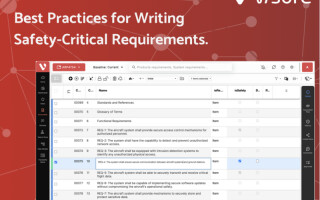
Best Practices for Writing Safety-Critical Requirements
July 24, 2025
Blog
In safety-critical domains such as aerospace, defense, and military systems, the quality of your requirements can make or break mission success. Poorly written or ambiguous requirements are a leading cause of system failures, delays, and non-compliance with regulatory standards like DO-178C, ARP4754A, and MIL-STD-882. In this article, I draw on two decades of experience helping engineering teams improve their Requirements Engineering processes to share best practices for writing clear, verifiable, and traceable safety-critical requirements. Whether you're working on autonomous platforms, mission systems, or advanced avionics, these principles will help you reduce risk and drive better outcomes.
Introduction: Why Writing Good Requirements Matters
Over my years working with defense and aerospace programs, I’ve seen firsthand how even a single poorly written requirement can derail an otherwise well-engineered system. In safety-critical systems, where lives and missions are on the line, vague or contradictory requirements are unacceptable.
Yet many teams still struggle with writing high-quality requirements. Why? Often, it’s a combination of unclear processes, lack of training, and the absence of the right tools. Getting requirements right from the start is the most cost-effective way to reduce downstream risk.
What Makes a Safety-Critical Requirement “Good”?
In my work as a trainer and consultant, I always emphasize that a high-quality safety-critical requirement must be, at a minimum:
- Clear and unambiguous
- Verifiable and testable
- Traceable to a higher-level requirement or stakeholder need
- Feasible given technical constraints
- Consistent with related requirements
These characteristics ensure that every requirement contributes to a safer, certifiable system.
Best Practice #1: Use a Structured Syntax and Templates
One of the fastest ways to improve requirement quality is by using structured templates. These encourage consistency and reduce ambiguity. A quintessential format is:
“The [system/subsystem] shall [verb] [object] [qualifiers or conditions].”
For example:
“The flight control computer shall initiate a safe mode within 250 ms upon detection of a loss of GPS signal.”
Standardizing this syntax helps ensure completeness and makes requirements easier to review, implement, and test.
Another structure syntax that gained traction in the past decades is Easy Approach to Requirements Syntax (EARS), which includes a simple ruleset of the most common types of requirements.
Best Practice #2: Avoid Ambiguous Terms
Ambiguity is the enemy of verification. Words like “fast,” “adequate,” “support,” “as needed” introduce subjectivity and make it impossible to determine when a requirement is fulfilled.
Instead, use quantifiable language. Replace vague phrases with measurable criteria:
- ❌ “The system shall start quickly.”
- ✅ “The system shall start within 3 seconds of power-on.”
Training engineering teams to recognize and eliminate ambiguity has an immediate impact on requirement quality.
Best Practice #3: Define Verifiability Upfront
For every requirement, ask: “How will I verify this requirement is met?”
Including the verification method alongside the requirement, whether by test, inspection, analysis, or demonstration, clarifies the development and V&V approach.
Modern Requirements Management platforms allow teams to associate each requirement with its verification activity, ensuring complete traceability from requirement to evidence.
Best Practice #4: Break Down Complex Requirements
Safety-critical systems often require complex behavior. However, embedding multiple ideas into a single requirement is risky.
For instance:
❌ “The software shall log the event and send a notification, and store the result in memory if a fault is detected.”
This should be split into separate, atomic requirements:
✅ “The software shall log the event if a fault is detected.”
✅ “The software shall send a notification if a fault is detected.”
✅ “The software shall store the result in memory if a fault is detected.”
This makes verification and change impact analysis far easier.
The use of structured syntaxes such as EARS may alleviate this issue.
Best Practice #5: Ensure Full Traceability
Safety-critical standards demand traceability, from high-level stakeholder needs down to hardware/software implementation and tests.
Tools like Visure’s ALM platform enable bi-directional traceability across the entire requirements lifecycle. With AI assistance, trace link suggestions and impact analysis can be automated, reducing manual effort.
Traceability isn’t just about compliance; it’s about ensuring nothing falls through the cracks.
Best Practice #6: Conduct Peer Reviews Early and Often
Requirement reviews are essential quality gates. They are the single most effective way to reduce issues in the requirements. I recommend holding structured peer reviews at the:
- Draft stage
- Post-integration stage
- Pre-validation stage
Use checklists that evaluate requirements for clarity, verifiability, and alignment with safety standards. Collaborative reviews using integrated tools also help teams resolve ambiguities before they impact downstream activities.
Best Practice #7: Leverage Reuse and Libraries
Many safety-critical projects share similar functionalities. Reusing well-vetted requirements from previous programs or libraries can accelerate development and reduce risk.
However, reuse must be controlled. Always:
- Verify applicability to the new context
- Update traceability and verification links
- Review against current standards
At Visure, we use AI to assist in identifying reusable requirements across projects, making reuse faster and safer.
Final Thoughts: Good Requirements Save Lives
In military and aerospace systems, quality requirements are not just a best practice; they are a safety imperative.
Investing in better requirement writing processes, tools, and training pays off in fewer defects, faster certifications, and more resilient systems. Whether you're developing flight control software, radar systems, or autonomous vehicles, applying these best practices can help ensure that every requirement leads to safer and more successful outcomes.
At Visure Solutions, we partner with engineering teams to embed these principles into their tools and workflows, empowering them to write better requirements, faster, and with confidence.
Check out this comprehensive Step-by-Step Course by Visure on How to Leverage AI for Great Requirements and Appendix C: How to Write a Good Requirement by NASA.
I’m Fernando Valera, CTO at Visure Solutions and an IREB Certified Requirements Engineering Trainer. With nearly 20 years in Requirements Management, I help global organizations define, manage, and trace complex, safety-critical requirements. At Visure, we deliver leading ALM platforms that ensure full lifecycle coverage and compliance in regulated industries.
For more information, visit: Visure Solutions and Visure Solutions’ LinkedIn

Fernando Valera, CTO at Visure Solutions and an IREB Certified Requirements Engineering Trainer. With nearly 20 years in Requirements Management, I help global organizations define, manage, and trace complex, safety-critical requirements. At Visure, we deliver leading ALM platforms that ensure full lifecycle coverage and compliance in regulated industries.