Energy Management Is Harnessed Thanks To iAMT On the Right Embedded Computing Platform
February 17, 2026
Blog

Energy management, in the context of digital energy and the smart grid, refers to the monitoring, control, and optimization of energy generation, distribution, and consumption using (digital) data-driven and automated technologies. It extends beyond traditional analog/power system operation by integrating real-time measurements, advanced analytics, and intelligent control across the entire system, whether that system is within a box, within a building, or within a city. And it includes the complete chain from generation to consumption.
At its core, digital energy management takes advantage of sensors, intelligent electronic devices, advanced metering, and communication networks to convert raw electrical data into actionable insights. These insights enable operators to dynamically balance supply and demand, reduce losses, and maintain power quality and reliability under increasingly complex operating conditions.
As the amount of electrification and the use of renewable energies increase, effective energy management becomes a critical enabler for transforming the grid into an adaptive, self-aware, and economically optimized cyber-physical system. From a design perspective, energy management is both a control and systems-integration challenge. It requires aligning protection, automation, and cybersecurity with a fixed set of objectives around such as efficiency, resilience, and sustainability.
Energy Management At the Box Level
Today, energy management is implemented through digital platforms that combine supervisory control and data acquisition (SCADA), energy management systems, and Cloud-based analytics. Utilities and large energy consumers use these tools to forecast load and generation, dispatch resources, manage congestion, and automate demand response. Real-time visibility into grid and facility operations enables faster decision-making, predictive maintenance, and optimization across multiple time horizons for protection and control, as well as planning purposes.
Before the relatively recent push for digital power management, this task was mostly manual and siloed. System operators relied on static schedules, and offline studies to balance supply and demand. Control actions were often reactive, based on operator experience rather than continuous optimization. Demand-side participation was minimal, with little ability to measure or influence end-use consumption in real time.
Looking ahead, energy management will become increasingly autonomous, adaptive, and decentralized. Advances in Edge computing and AI will enable closed-loop optimization across grid-connected assets. Energy management will evolve from monitoring and control toward well-orchestrated compliance.
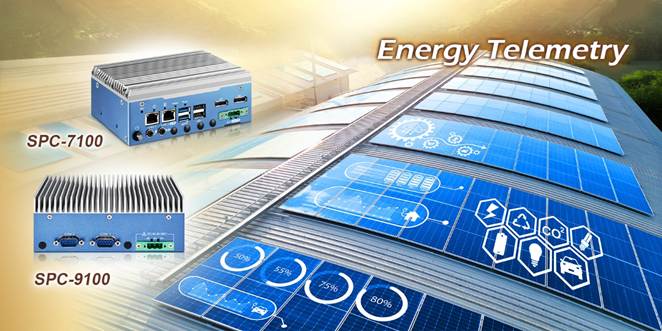
Caption: The SPC-7100 and 9100 embedded PCs are purpose-built for energy telemetry, combining rugged, fanless designs with high-performance compute to reliably collect, process, and analyze power and sensor data at the Edge.
iAMT Drives Efficiency
One tool that helps support energy management is Intel’s Active Management Technology (iAMT), which maximizes the control administrators have over their systems. Because iAMT runs on a dedicated management engine within Intel–based platforms, it can monitor and manage power independently of user activity. In fact, iATM allows IT administrators to remotely manage and troubleshoot systems even if the operating system is not running or the machine is powered off.
That remote power control is a key energy-saving capability within the confines of iAMT. Administrators can power systems on, off, reset them, or place them into low-power states (such as sleep or hibernate) from a central console. This enables scheduled shutdowns during non-business hours and automated wake-ups for maintenance tasks like patching or backups, avoiding the need to leave machines running overnight. iAMT also supports hardware-level inventory and status monitoring, allowing admins to identify idle or underutilized systems and apply power policies accordingly. The end result is that iAMT helps reduce electricity consumption, lower cooling requirements, and extend hardware lifespan.
Requirements Met
In one specific example, a customer based in Athens, Greece, came to the Vecow development team with a series of requests aimed at energy management. They needed:
- fanless operation
- an operating temperature no higher than 70℃
- compact size
- low power consumption
- a BIOS that offers remote access
- remote keyboard, video, and mouse control without a connected display
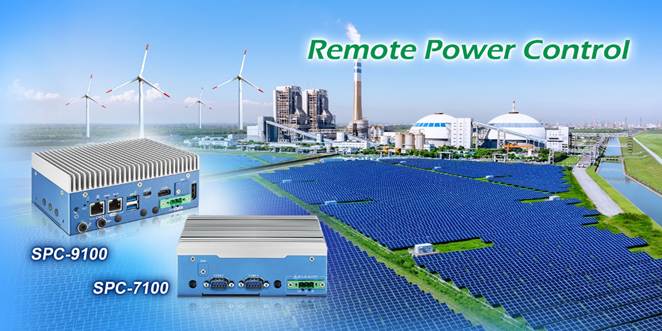
Caption: Vecow’s SPC-7100 and SPC-9100 embedded PCs are well suited for remote power control applications, delivering reliable, fanless edge computing to monitor and manage distributed power assets in real time.
The Vecow SPC‑7000 is up to the task of handling these tasks. In a compact form factor (roughly 150 by 105 by 48 mm), the platform’s fanless design reduces component count and lowers both the power consumption and the noise generation. The SPC‑7000’s thermal design varies based on the specific model, starting at –40 °C and ranging up to +70 °C without any active cooling assistance.
Remote access is handled by the SPC-7000’s use of iAMT, as it supports a Gigabit LAN port to enable out-of-band management. In addition, iAMT can be configured such that administrators can access BIOS settings remotely, perform power control (wake/sleep/boot), and use remote console redirection, including remote keyboard, video, and mouse (KVM) control via network protocols even without a local display connected.
Focus on the SPC-7000
Looking specifically at the features of the Vecow SPC-7000, it’s a rugged, ultra-compact embedded system designed for industrial, AIoT, and Edge computing applications that demand efficiency, reliability, and remote manageability. At its core, the platform features 11th Gen Intel Core i7/i5/i3 Tiger Lake processors with configurable thermal design power (cTDP), up to about 28 W. Hence, it can balance strong compute performance and low power consumption for energy-sensitive deployments. As previously stated, its fanless design and robust thermal engineering allow operation across extended temperature ranges, eliminating fans that consume power and fail over time while enabling passive heat dissipation in harsh environments.
The system supports up to 32 GB of DDR4 memory, dual DisplayPort outputs with high-resolution graphics, multiple high-speed USB ports, and flexible expansion options including 1 and 2.5 GbE networking. TPM 2.0 support, a wide DC-input voltage range (9 to 55 V), and optional AI and wireless connectivity make the SPC-7000 a versatile, energy-aware platform for modern automated and remote environments.
One more important point—Vecow has upped its game with the release of the SPC-9000. The newer system differs primarily in its processing platform and performance capability. The SPC-9000 leverages the newer Intel Core Ultra processor family, which integrates a hybrid CPU, GPU, and AI acceleration (NPU) with DDR5 memory and expanded high-speed I/O, including multiple 2.5 GbE ports and more storage/expansion flexibility.
Summary
In summary, Vecow’s SPC-7000 proved to be the right solution for the customer’s application because it aligns closely with the technical and operational demands of modern energy management systems. Its industrial-grade design, long lifecycle support, and high computational performance make it well suited for continuous operation in substation, control room, or Edge-grid environments. The platform’s support for real-time data processing, multiple I/O interfaces, and secure networking enables seamless integration with SCADA and distributed energy resource management system (DERMS) architectures. By hosting analytics and control functions close to the grid, the SPC-7000 reduces latency, improves system resilience, and supports scalable, future-ready digital energy deployments.
Vecow serves as a great partner in this space because it combines deep expertise in industrial computing with long-term product availability, rugged reliability, and customization support, all key requirements for deploying secure, scalable, and mission-critical energy management solutions in smart grid environments. And the company operates globally. For more information, contact Vecow directly.