Deploy Channel Sounding In Your Bluetooth Devices
December 16, 2025
Sponsored Blog
Bluetooth Channel Sounding is a method of precisely measuring the distance between two Bluetooth Low Energy (LE) devices, down to just a few centimeters. In simple terms, it lets one device know exactly how far away another is. The technology relies on two complementary techniques: Phase-Based Ranging (PBR) and Round-Trip Time (RTT).
With PBR, an “initiator” device and a “reflector” exchange tones across up to 72 Bluetooth channels. By analyzing how the phase of each tone changes when it returns, the system can estimate distance very accurately. RTT measures how long those signals take to travel back and forth. Combining both methods produces reliable, secure, and highly precise results, even in busy RF environments.
Bluetooth devices have previously used Received Signal Strength Indication (RSSI) to estimate proximity. RSSI looks at how strong a signal appears to be when received, based on the simple idea that signal strength drops as distance increases. While it’s useful for rough distance estimates, RSSI has limits. Interference from walls, metal, furniture, and even people can cause the signal to bounce, weaken, or fluctuate, making results unpredictable.
Channel Sounding Is New To the Spec
Although Channel Sounding itself isn’t a new technique, its recent integration into the Bluetooth Core 6.0 specification has made it practical and affordable for everyday devices, as it can leverage the same low-cost, low-power silicon already used in billions of products. That opens up a huge range of possibilities for applications that need its accuracy and efficiency.
The most obvious uses are in access control, security, and location tracking. For example, a smart lock could open automatically only when a paired phone or tag is within a specific distance, adding convenience without sacrificing safety. In industrial or healthcare environments, Bluetooth Channel Sounding can power indoor navigation or asset-tracking systems, helping to locate equipment, inventory, or even people in real time.
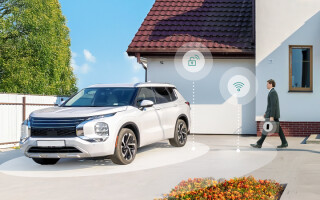
Automotive applications are another strong fit. In digital key systems, Channel Sounding verifies not only that the key fob is genuine, but also exactly where it is in relation to the car. That prevents “relay attacks,” where someone tries to trick the system by relaying signals from a distance. Since PBR and RTT work together, it’s extremely difficult for an attacker to spoof or forward the data. Some vehicles may even use multiple Bluetooth “anchors” around the car to triangulate the fob’s position, confirming whether it’s next to the driver’s door, the trunk, or inside the vehicle.
For designers, Channel Sounding does introduce some RF challenges. Over-the-air communication is affected by reflections and interference, known as multipath effects, which can complicate measurements. That’s why it’s important to work with a partner that has deep experience in wireless and RF design.
Alternative Techniques
Of course, Bluetooth isn’t the only option for distance measurement. Wi-Fi and Ultra-Wideband (UWB) are also used, but each carries its own trade-offs. Wi-Fi is widely available but typically uses more power and offers less accuracy than Bluetooth LE. UWB is extremely precise and already deployed in many automotive and smartphone systems, but it requires dedicated silicon, making it more expensive and power-hungry. Bluetooth LE, by contrast, delivers a balance of accuracy, power efficiency, and cost-effectiveness, and it’s already built into almost every smartphone, making adoption far simpler.
If you’re not yet exploring this technology, now’s the time. Infineon, a long-time leader in Bluetooth and other wireless solutions, is helping customers integrate Channel Sounding into new designs (for more detailed, technical information, check out the whitepaper Enable Secure, Fine-Ranging Measurements with Bluetooth-Based Channel Sounding). The company’s expertise and product roadmap make it easier to take advantage of this powerful new capability and bring secure, high-precision ranging to a wide range of applications, from smart homes to smart cars.

Semiconductors are crucial to solve the energy challenges of our time and shape the digital transformation. This is why Infineon is committed to actively driving decarbonization and digitalization. As a global semiconductor leader in power systems and IoT, we enable game-changing solutions for green and efficient energy, clean and safe mobility, as well as smart and secure IoT. We make life easier, safer, and greener. Together with our customers and partners. For a better tomorrow.