
Industrial Predictive Maintenance Maximizes AI at the Edge
January 05, 2026
Sponsored Blog
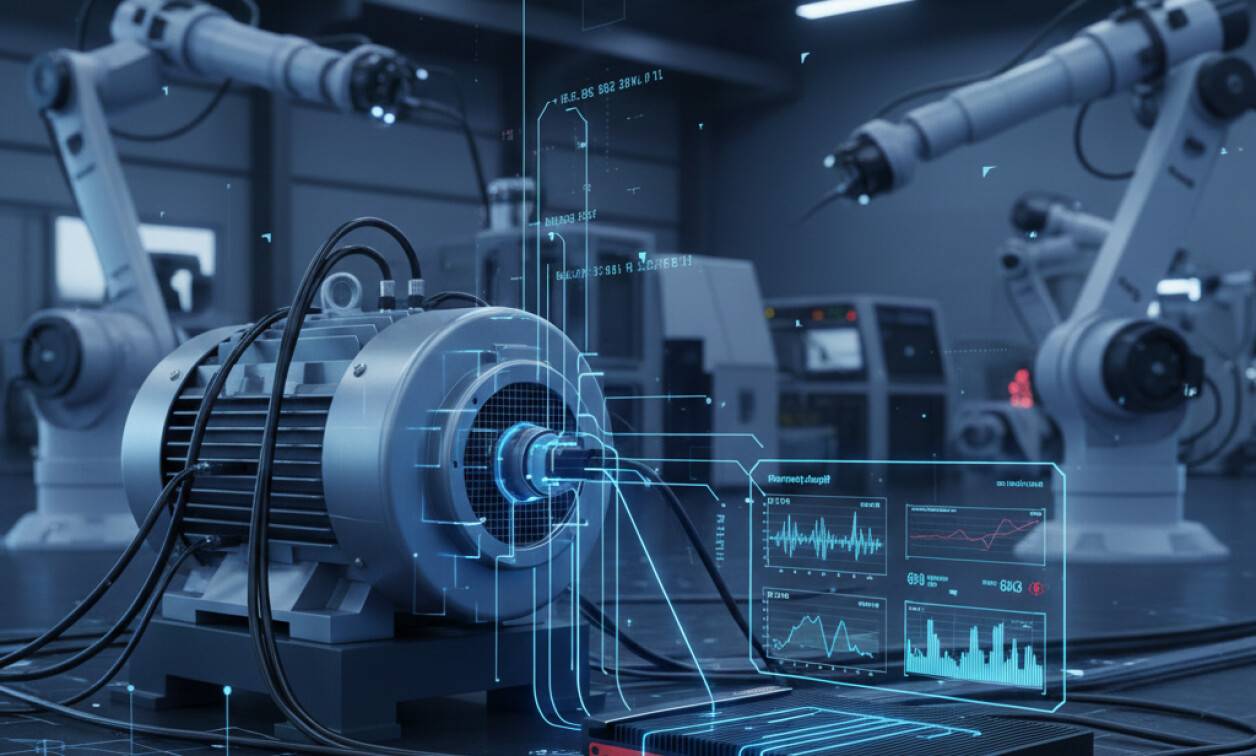
Equipment downtime in a manufacturing facility, or in almost any industrial environment, represents more than just an inconvenience. It is a direct hit to a vendor’s productivity, profitability, and brand. As production lines become more automated and capital-intensive, the tolerance for unexpected failures continues to shrink. That reality is driving manufacturers toward predictive maintenance, where AI and machine learning are used to detect failures long before they result in unplanned shutdowns.
Among the many asset-health indicators available, motor vibration analysis remains one of the most proven and effective techniques when it comes to predictive maintenance. It can uncover early-stage issues such as bearing wear, shaft misalignment, imbalance, gear defects, and lubrication degradation well before catastrophic failure occurs, allowing corrective action to be taken. However, extracting actionable insights from vibration data requires substantial signal-processing capability, especially when analysis must be performed continuously and in real time. This is where Edge computing becomes essential.
The Role of FFT Processing at the Edge
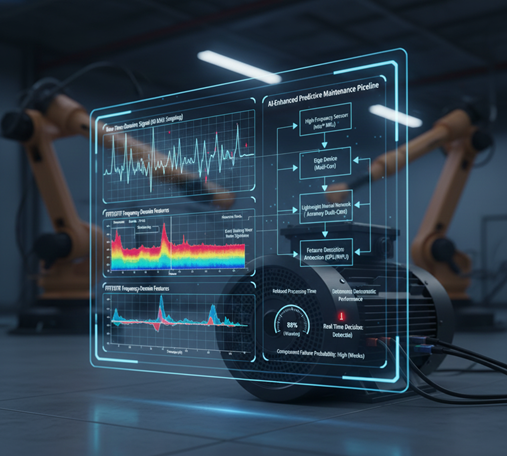
Motor vibration sensors often sample at rates ranging from around 5 kHz up to about 50 kHz. Before AI algorithms can assess machine health, raw time-domain data must be transformed into frequency-domain representations that reveal meaningful fault signatures. Fast Fourier transform (FFT) and short-time Fourier transform (STFT) processing are foundational to this workflow.
As you might expect, executing these transforms at the Edge demands more than basic compute horsepower. The platform must deliver low latency, high throughput, and deterministic behavior, all while operating reliably in harsh industrial environments. This is why many modern predictive-maintenance systems rely on the Intel® oneAPI Math Kernel Library (oneMKL). oneMKL is optimized for signal-processing workloads on Intel CPUs and GPUs, providing accelerated FFT performance that serves as the building block for efficient STFT implementations.
By leveraging Intel® MKL, FFT workloads execute faster and with more predictable timing, even when multiple vibration channels are being processed simultaneously. The result is real-time responsiveness that enables localized analytics and eliminates the need to stream raw data to the Cloud, reducing bandwidth requirements and improving system reliability.
FFT Acceleration Directly Impacts Predictions
Keep in mind that FFT processing isn’t just a preprocessing step; it’s the determining factor when it comes to effective AI inference. High-frequency vibration data must be converted into spectral features quickly enough to keep pace with sensor inputs. Intel® MKL improves this pipeline by fully exploiting multi-core CPU architectures, reducing processing time for both small and large transform windows, and maintaining consistent performance under sustained workloads.
Once frequency-domain features are available, lightweight neural networks or anomaly-detection models can execute locally using the integrated GPU or NPU available on modern processors. This hybrid CPU, GPU, and NPU approach provides the most efficient balance of performance and power consumption, which is particularly important in fanless, always-on industrial systems.
MiTAC Platforms Built for Vibration AI
MiTAC’s MP2-10MTS and PD10MTS platforms provide a strong hardware foundation for vibration-based predictive maintenance. Both systems are based on Intel® Meteor Lake-U processors and share the same underlying compute architecture, including Intel® Iris Xe Graphics and integrated AI acceleration. While the MP2-10MTS is a fanless embedded system and the PD10MTS is a compact 3.5-inch single-board computer, both are engineered for industrial deployment and long-term reliability.
The multi-core Meteor Lake-U CPU is well suited for FFT workloads accelerated by Intel® MKL, while the integrated GPU supports machine-learning inference. Intel® AI Boost, implemented as an on-chip NPU, allows anomaly-detection models to run with improved power efficiency. Together, these capabilities support continuous sensor acquisition, real-time FFT preprocessing, and AI inference directly on the factory floor.
From an I/O perspective, both platforms offer the connectivity required for industrial environments, including multiple 2.5-Gbit Ethernet LAN ports, serial interfaces, GPIO, and USB. This makes it straightforward to interface with vibration sensors, gateways, PLCs, and controllers. Storage support for NVMe and SATA enables long-term waveform logging and historical trend analysis, while M.2 expansion allows for wireless connectivity or additional accelerators if needed.
Equally important is the mechanical and thermal design. Fanless operation, compact form factors, wide-temperature support, and resistance to shock and vibration allow these systems to be deployed close to motors and rotating machinery without compromising reliability.
Detecting Faults Before Failure Occurs
With continuous FFT-based spectral analysis enabled by Intel® MKL and localized AI inference, MiTAC’s MP2-10MTS and PD10MTS platforms can identify subtle fault signatures that are often missed by threshold-based monitoring. These include high-frequency harmonics associated with bearing defects, low-frequency imbalance, harmonic distortion caused by shaft misalignment, gear mesh frequency sidebands, broadband energy increases linked to lubrication breakdown, and resonance shifts that indicate structural looseness.
Detecting these conditions early allows maintenance teams to intervene proactively. The result is reduced downtime, lower repair costs, and extended asset lifespans, which is the promise of predictive maintenance. However, those results can only be achieved with the correct hardware-software mix.
Example of a Practical Edge-Based Workflow
In a typical deployment, accelerometers capture vibration signals at high sampling rates and stream them directly to an Edge system such as the MP2-10MTS or PD10MTS. FFT processing, accelerated by Intel® MKL, converts time-domain signals into frequency-domain data in real time. Feature extraction and AI inference then run locally on the GPU or NPU to identify abnormal patterns. Alerts are issued to SCADA systems, MES platforms, or local HMIs as soon as anomalies are detected. If required, summarized data or selected waveforms can be synchronized with centralized servers or cloud platforms for fleet-level analysis.
This tightly integrated hardware and software stack delivers exactly what is needed—fast, deterministic, and reliable motor-health diagnostics without sacrificing system robustness.
Why MiTAC Continues to Matter in Industrial AI
MiTAC has long been a familiar name in the embedded space, and for good reason. The company has built its reputation on delivering industrial-grade computing platforms designed for continuous 24/7 operation, long lifecycle support, and compliance with demanding environmental requirements. These attributes are not optional in factory automation; they are foundational.
What differentiates MiTAC is its consistent focus on the “engineering intangibles,” meaning that it develops its products under a watchful eye. From thermal design to mechanical robustness and I/O longevity, its platforms are built to deploy once and run reliably for years. Add global support infrastructure and compatibility with Intel® MKL, OpenVINO™, and mainstream AI frameworks, and MiTAC platforms become a practical choice for real-world industrial AI deployments.
For developers building predictive maintenance systems based on real-time vibration analysis, the MP2-10MTS and PD10MTS provide a future-proof and dependable foundation. In an environment where downtime is unacceptable, that level of reliability matters. Contact the company today to learn more.