embedded world Product Showcase: Ambient Scientific’s GPX10 Pro
March 09, 2026
Sponsored Story
Battery-powered edge AI devices are becoming increasingly more complex. Applications that perform keyword spotting, face ID, and intelligent sensing are often deployed within small, portable devices that must deliver high-performance AI inference and execute AI algorithms for neural networking models, in power-constrained solutions.
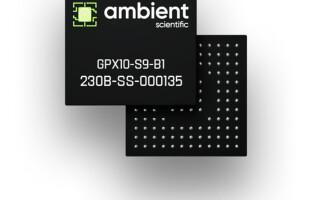
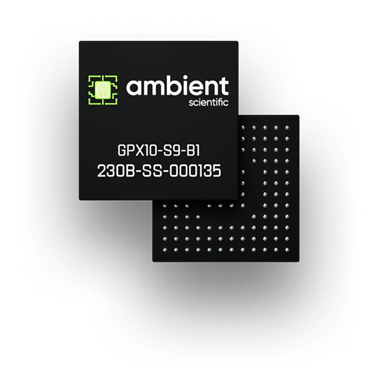
Designed as a versatile processor for always-on, battery-powered embedded AI applications in edge devices is the GPX10 Pro from Ambient Scientific. The system-on-chip (SoC) uses AI-native silicon technology to efficiently perform the previously mentioned tasks and edge functions to rival today’s existing MCUs, NPUs, and GPUs.
This will focus on the GPX10 Pro, while also highlighting some features of the GPX10.
Ambient Scientific’s GPX10 Pro in Action
The programmable AI processor supports AI algorithms such as RNN, LSTM, GRU, CNN, MNN, and more, while also enabling custom AI Algorithms designed from scratch. The SoC is made up of ten MX8 advanced AI processor cores using DigAn technology with a custom ISA.
Leveraging an ARM M4F for executing non-AI workloads, the control processor on the GPX10 Pro can execute classical algorithms and configure and assist MX8 cores with deep learning data flow tasks.
The GPX10’s always-on detection can run AI models while consuming less than 80 microwatts of power. It supports charger-less AI applications by harvesting energy from natural sources like kinetic energy and RF energy, and provides years of always-on AI on one coin-cell.
With ultra-low power consumption, the GPX10 supports a multi-channel ADC. And at the system level, provides as low as 50uW for sensor fusion. Sensor fusion can also be achieved by connecting up to 10 analog and digital sensors simultaneously.
Getting Started with Ambient Scientific’s GPX10 Pro
The GPX10 is designed to suit varying applications by leveraging versatility and flexibility for software-defined Programmable AI cores, and support for multiple operand resolutions for weights and inputs to be modified dynamically for performance and power consumption. Additionally, each core can be enabled, disabled, and halted dynamically.
The aforementioned DigAn AI engine can also change behavior between being a master or slave.
For additional support, Ambient Scientific provides the SenseMesh hardware sensor fusion layer and a comprehensive Nebula AI enablement toolchain. The toolchain is designed to accelerate the training, development, and deployment of AI models to the GPX10 and GPX10 Pro, and is compatible with TensorFlow, Keras, and ONNX. The chip's AI cores are also programmable in the Nebula toolchain.
Additional Resources:
- Press Release: https://www.prnewswire.com/news-releases/new-ai-native-processor-for-edge-applications-offers-100x-power-and-performance-improvements-over-32-bit-mcus-302558828.html
- Product Page: https://www.ambientscientific.ai/product
- Fall Detection Demo: https://www.youtube.com/watch?v=PXOoe6E8X_A
- Product Animated Video: https://www.youtube.com/watch?v=X7vjOZNckIk

Tiera Oliver is the assistant managing editor at Embedded Computing Design. She is responsible for web content editing, product news, and story development. She also manages, edits, and develops content for ECD podcasts, including Embedded Insiders.
She utilizes her expertise in journalism and content management to oversee editorial content, coordinate with editors, and ensure high-quality output across web, print, and multimedia platforms. She manages diverse projects, assists in the production of digital magazines, and hosts company podcasts by conducting in-depth interviews with industry leaders to deliver engaging and insightful discussions.
Tiera attended Northern Arizona University, where she received her bachelor's in journalism and political science. She was also a news reporter for the student-led newspaper, The Lumberjack.