Application Highlight: How Physical AI Hardware Platforms, AI SDKs, and Strategic Partnerships are Overcoming Old Pain Points
March 09, 2026
Sponsored Story
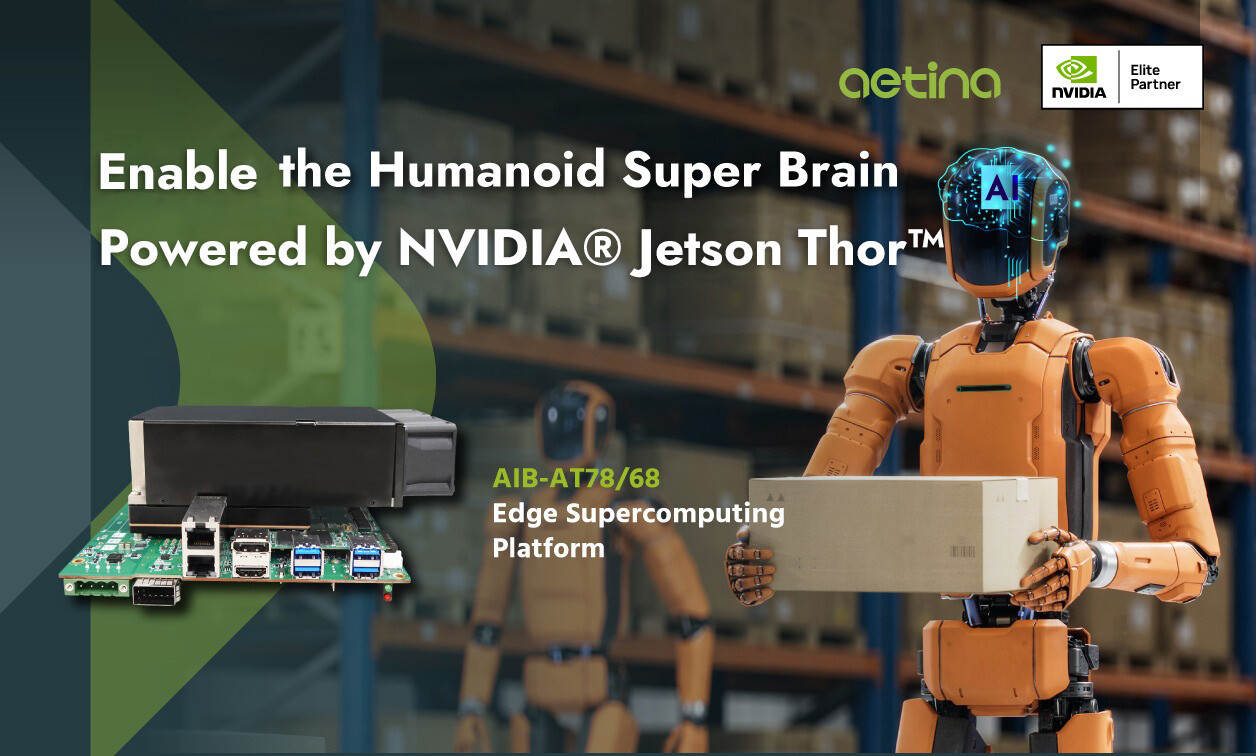
The world is ready for humanoid robots. Logistics and manufacturing face serious labor shortages, driving automation urgency. In healthcare, medical professionals are overstretched due to aging populations and staffing issues.
But despite this demand, OEMs and SIs struggle to translate humanoid robot prototypes into deployable systems that can operate in real-world environments. This “sim-to-real gap” is frustrating, but unsurprising. There are many hardware and software challenges involved in building physical AI applications:
- Inadequate compute: Humanoid robots must simultaneously manage complex motion and multimodal AI reasoning. These demanding edge AI workloads are often beyond the capabilities of traditional IPCs.
- Insufficient I/O: Many edge computing modules lack the bandwidth and connectivity required by solutions with extensive sensors and high data throughput.
- AI engineering challenges: Humanoid robot development involves multiple, complex software engineering tasks, increasing development difficulty, cost, and time to market.
The good news, however, is that the landscape of embodied AI development has changed enormously over the past several years.
Platforms designed for physical AI use cases, such as Aetina’s AIB-AT78/68, powered by NVIDIA Jetson Thor, can now deliver the raw AI computing power and rich connectivity needed for humanoid robot applications.
Developments in robotics and AI ecosystems are also eliminating obstacles. The declining cost of humanoid robot actuators is finally making commercial deployment feasible. And recent breakthroughs in robotics foundation models, such as NVIDIA Isaac GR00T, have simplified AI software development.
Aetina’s AIB-AT78/68, for example, allows engineers to leverage the rich NVIDIA software development ecosystem to solve complex sensor fusion and integration challenges. In addition, when working with an NVIDIA Elite Partner like Aetina, which receives early access to technology and engineering support from NVIDIA, developers get insider help integrating and optimizing compute and system components.
By leveraging embodied AI technologies and the expertise of technical partners like Aetina, OEMs and SIs can bring viable humanoid robot systems to market—not in some imagined science-fiction future, but right now.
Sim-to-Real: Two Case Studies
Case in point: Aetina’s recent deployments at two companies. One company wanted to build general-purpose humanoid robots for safety-focused facilities. The second needed humanoids for logistics in factory warehouses.
Both development teams were looking for a computing platform capable of autonomous decision-making, real-time sensor data processing, and multimodal AI inference. This was critical, because in unstructured environments like warehouses, humanoid robots may need to process up to 15 GMSL camera feeds, multiple LiDAR streams, and radar data simultaneously to make split-second decisions about balance, navigation, and task execution. Traditional x86-based IPCs proved inadequate, as they lacked the unified memory architecture and tensor-core density to run multimodal AI models alongside real-time motor control.
Integration issues were another mutual pain point. The first company needed its computing platform to work synergistically with a separate mechanical control platform—and then integrate the robot’s sensors with its “AI brain” and mechanical controller—in order to create a unified system that could operate safely and reliably. The other company had integrated its LiDAR and radar sensors, but stereo GMSL camera data was still a problem.
Aetina helped both teams overcome their challenges and deliver real-world applications.
The Aetina AIB-AT78/68, powered by NVIDIA Jetson Thor, delivered a high-performance computing platform for physical AI. Based on the NVIDIA Blackwell GPU architecture, NVIDIA Jetson Thor delivers up to 2070 FP4 TFLOPS of AI inference performance and excellent energy efficiency—up to 7.5x higher AI compute and 3.5x better efficiency compared to NVIDIA Jetson AGX Orin.
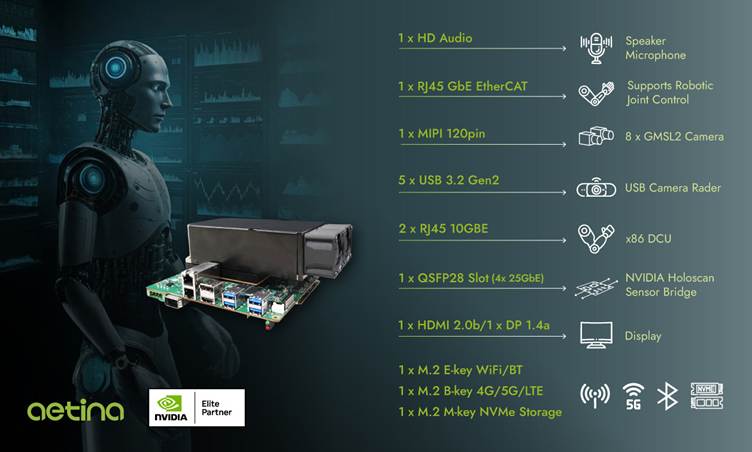
In addition, the AIB-AT78/68’s market-leading I/O was a significant help. The 1x QSFP28 slot (4x25GbE) provided high-speed connectivity to support the NVIDIA Holoscan Sensor Bridge and meet high sensor fusion requirements. Together with the platform’s 1Gb EtherCAT and dual 10GbE LAN ports, this enabled the system engineers to develop a high-performance robotic “nervous system” capable of achieving 41+ degrees of freedom (DoF) for fluid, human-like mobility, dexterity, and response.
The NVIDIA software ecosystem and Aetina’s technical assistance were also crucial to overcoming engineering challenges. Aetina’s ready-to-ship software, based on the NVIDIA JetPack 7 SDK, provided a strong foundation for accelerated AI software development.
Aetina also provided direct engineering support. To ensure 360° visual awareness, they helped integrate high-fidelity cameras across the humanoid robot’s head and body. During validation, Aetina worked with the second company to integrate its stereo GMSL camera sensor data into the system. By enabling real-time fusion of camera, LiDAR, IMU, force-torque, and proprioceptive data, human-like response in unstructured environments was achieved. If the humanoid robot’s IMU detected a stumble, for example, this triggered an instant camera refocus and balance adjustments within 10ms.
These case studies show how high-performance hardware, AI SDKs, and expert technical support come together to enable field-ready humanoid robots.
Mature physical AI ecosystems and technical partnerships speed development
Aetina’s AIB-AT78 and AIB-AT68 computing platforms are purpose-built for embodied AI. Unlike the evaluation boards offered by some vendors, the platforms are deployment-ready. Built on NVIDIA Jetson Thor, AIB-AT78/68 delivers unmatched AI inference capabilities, a strong power-performance balance, and a compact form factor:
|
Feature |
AIB-AT78 |
AIB-AT68 |
Benefits |
|
Processing |
NVIDIA Jetson T5000 module:
2560-core NVIDIA Blackwell architecture GPU with 96 fifth-gen Tensor Cores
14-Core ARM Neoverse V3AE CPU |
NVIDIA Jetson T4000 module:
1536-core NVIDIA Blackwell architecture GPU with 64 fifth-gen Tensor Cores
12-Core ARM Neoverse V3AE CPU |
Enables up to 2070 FP4 TFLOPS (AIB-AT78) or 1200 FP4 TFLOPS (AIB-AT68) of AI inference power across processors. |
|
Form Factor |
140mm x 165mm x 42.8mm (excluding cooling) |
Compact form factor fits easily into robot chassis. |
|
|
I/O |
1x QSFP28 slot (4x25GbE) 2 x RJ45 10GbE LAN 1 x RJ45 1GbE EtherCAT 1 x USB-C 3.2 Gen2 1 x HDMI 2.0b 1 x HD Audio-in/out 1 x M.2 M with NVMe Storage (PCIe Gen5) |
Supports NVIDIA Holoscan Sensor Bridge and enables deterministic, low-latency control of robot body, supporting 41+ DoF. |
|
|
Temperature |
-25°C to 80°C |
Rated for industrial use to ensure reliable operation in challenging environments. |
|
|
Memory |
128GB LPDDR5X |
64GB LPDDR5X |
Ample memory enables larger perception models and accelerates AI sensor fusion and state-perception workloads. |
|
Power |
~130W power envelope |
Excellent performance-power balance improves battery life and simplifies thermal management. |
|
Beyond the hardware, the NVIDIA software ecosystem further streamlines humanoid robot development.
NVIDIA JetPack provides a firm development foundation, offering a comprehensive, well-documented framework for AI software engineering. NVIDIA Holoscan offers high-throughput, low-latency sensor fusion to enable robot perception, while NVIDIA Isaac GR00T provides AI foundation models for cognition and control. And NVIDIA Isaac Lab provides a robotics simulation and training environment, accelerating sim-to-real transfer and reducing development time from months to weeks.
Last but not least, partnership with Aetina enables OEMs and SIs to develop workable applications far faster. Aetina assists their customers by:
- Customizing and fine-tuning NVIDIA JetPack 7 for solution-specific requirements, reducing development work and optimizing performance.
- Delivering tailored Board Support Packages, ported to NVIDIA JetPack, with the help of Aetina firmware engineers’ experience in low-level driver development.
- Offering integration assistance on projects with extensive or complex external peripherals and sensors.
The support of Aetina enables solution developers to speed time to market, reduce risk, and scale seamlessly from prototype to full deployment.
The future of humanoid robots
Humanoid robots have been on hold for too long—hampered by insufficient compute, software engineering problems, and the complexities of sensor integration. But now, robust hardware, mature AI SDKs, and support from specialists like Aetina are overcoming these old pain points.
Practical, scalable embodied AI is closer than most people realize. Driven by strategic partnerships between solution builders and companies like NVIDIA and Aetina, humanoid robots are on the way.
To learn more about