The Hidden Complexity of Bluetooth Antenna Design in Channel Sounding
March 02, 2026
Blog

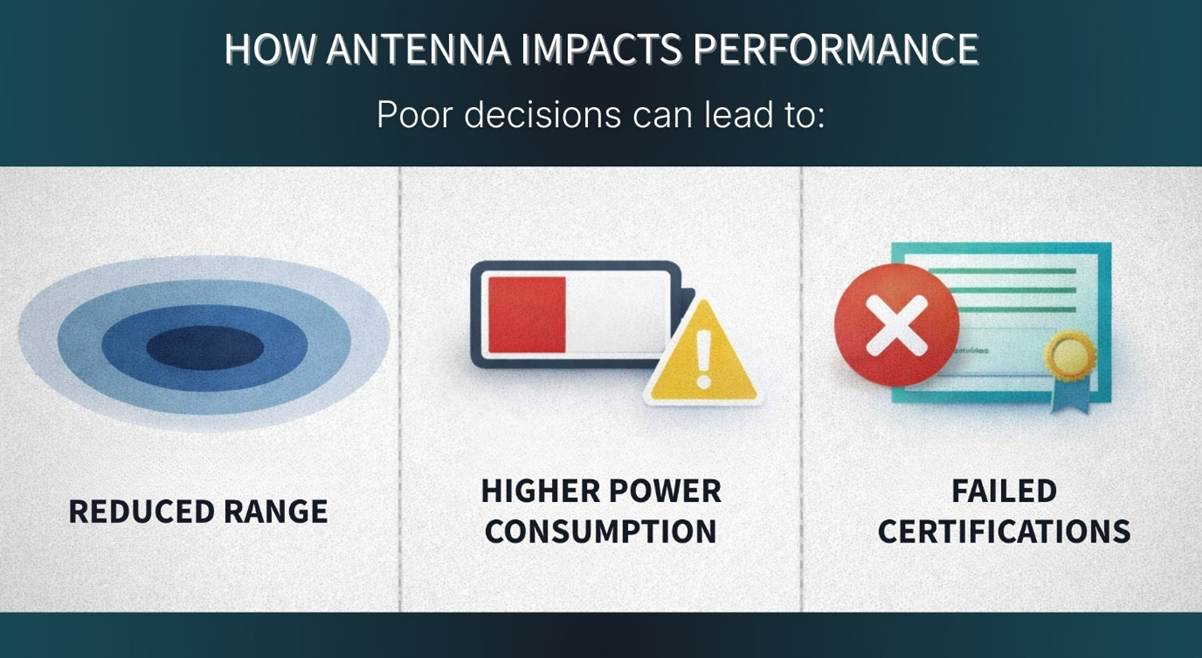
Bluetooth is often seen as a “plug-and-play” technology for embedded systems. Drop in a module, connect a few traces, and you’re done—right? Not quite, and especially with Channel Sounding. Behind the scenes, antenna design can make or break your product’s performance. Poor decisions lead to reduced range, higher power consumption, and even failed certifications.
This article explains the biggest antenna pitfalls in Channel Sounding projects and how to avoid them with practical design and validation steps.
The Problem: Why Bluetooth Antenna Design Sinks Embedded Projects
Most embedded engineers underestimate the complexity of Bluetooth antenna design. Using modules with integrated antenna removes the tedious work of optimizing antenna radiator (the component or trace associated with word “antenna”) but it exposes engineers for easy mistakes. Here’s why it matters:
- Placement and PCB Layout: Antennas are sensitive to their surroundings. A poorly placed antenna can lose efficiency and detune easily. Multiantenna systems such as Bluetooth Channel sounding require placement optimization of each antenna respect to PCB but also to each other’s to optimize envelope correlation coefficient(ECC) similar to 5G MIMO systems.
- Ground Plane and Housing Materials: Plastics, metals, and potting compounds can degrade performance dramatically. Well performing antenna can get utterly “destroyed” when placed next to metal.
- Coexistence with Other Radios: Bluetooth often shares space with Wi-Fi, LTE, or GNSS. Without careful planning, interference and spurious emissions become a nightmare to solve.
- Certification Risks: Poor antenna design leads to failed compliance tests, costly redesigns, and delayed product launches.
- Cost and Lost Opportunity: Projects where an antenna detuning is found at certification stage face several months of delays at product launch and extensive R&D costs due to tied personnel expenses and extra measurements.
The result? Delayed product launch, unstable connectivity, short range, and unhappy customers.
The Solution for Bluetooth Channel Sounding: Design Smart, Validate Early
The good news? These problems are preventable with the right approach for Bluetooth antenna design.
Choose the Right Antenna Strategy
Decide early whether you need a custom antenna or if an off-the-shelf solution could work. It is quite common that rough simulation is needed to decide the right strategy. Especially if you target for significant range and you cannot follow all guidance from antenna manufacturer to achieve your ECC and Group Delay targets.
Account for Material Impact
Potting and housing materials can detune antennas. Factor these effects into your design from day one. Professional antenna designers rarely recommend continuing with potted off-the-shelf solution without simulation because the antenna behaves completely differently if potted. Blog: Hardware potting - 5+1 tips to avoid problems with antennas.
Preparing for Advanced Features
Bluetooth is evolving. Features like Angle of Arrival (AoA) and Bluetooth Channel Sounding need multi-antenna setups and precise calibration. These aren’t optional if you want next-gen positioning accuracy.
Confirm and Calibrate
Combine lab measurements with simulations and field testing. This ensures performance but also mitigates CE and FCC compliance risks before certification and mass production.
Future-Proof Your Channel Sounding Antenna Design
Bluetooth 6.0 introduces Channel Sounding, enabling centimeter-level positioning. This is a significant change for IoT, industrial automation, and asset tracking — but only if your antenna design is ready.
If you’re designing for Bluetooth 6.0 and Channel Sounding, the physics and calibration details are too complex to guess — our Bluetooth channel sounding whitepaper gives practical guidelines based on real‑world designs and next-gen positioning.

Mikko Parkkila is the CMO and co-founder of Radientum. Parkkila started his career as an antenna engineer at Nokia and Microsoft, designing antennas and systems for smartphones, including multiband LTE MIMO antennas. In 2015, Parkkila co-founded Radientum with the aim of providing simulation-driven custom design services for wireless products.