
Protect Your Home from Thieves and Floods
February 25, 2026
Blog
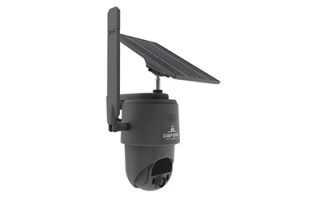
It’s always fun the weeks after CES, when some of the cooler the products you’ve seen on site in Las Vegas show up for real-life testing. This year, I took a look at two products, both wireless devices that are aimed at protecting the home.
First, the Defend 360 4G cellular security camera takes advantage of “off-grid surveillance.” Unlike traditional Wi-Fi cameras, the Defend 360 employs LTE cellular connectivity via an integrated eSIM to operate independently of a local Internet connection. This is especially advantageous for remote locations, like construction zones, agricultural properties, and other places where Wi-Fi is either unreliable or nonexistent. Did I mention that it’s powered by a self-contained solar panel and rechargeable battery? That gives it a “set it and forget it” approach.
The Defend 360’s 4G LTE Cat-1 cellular modem (multi-band support) is paired with a high-gain external antenna to ensure uplink reliability across most major carriers without requiring user-provided SIM cards or tethering to a phone plan. The key here is that the Defend ecosystem handles provisioning and signal selection automatically. It couldn’t have been much easier to install and deploy.
This approach permits direct cloud integration without intermediary gateways, reducing points of failure. In addition, it employs power-aware data scheduling, where image and video transmissions can be batched or scheduled to conserve both data and battery life.
A 20-Mpixel still capture capability combines with 1080p HD video for maximum visual fidelity. H.265 compression is employed to reduce bandwidth consumption without compromising detail. In addition, the camera offers automatic 355-degree pan and 75-degree tilt, meaning that one camera can cover a wide area.
Simple Flood Detection
.jpg)
The second product is the Shelly Flood Gen4 water intrusion detection platform, aka smart leak sensor. It combines multiprotocol radio connectivity with a modular sensor topology that expands coverage beyond traditional point-style flood detectors using a cable-like structure.
The Gen4’s support for Wi-Fi 802.11 b/g/n/ax, Bluetooth 5 (LE), and IEEE 802.15.4 Zigbee maximizes flexibility. I happen to run all of these protocols in my house, but Wi-Fi was the easiest to configure for me. It also touts Matter certification.
The device’s 2-meter leak sensor cable is a very compelling technical feature. In my case, I wrapped the cable around my hot water heater, so a leak from any side would trigger an alarm. I tested it on a few different sides and every one passed the test.
The unit runs on 4 AA cells, with an estimated two-year battery life under typical duty cycles, and is housed in an IP44-rated enclosure suited for humid and splash-prone locations.
In summary, these two products protect my home with minimal effort. Well worth the cost and effort in both cases.

Rich Nass is a regular contributor to Embedded Computing Design. He has appeared on more than 500 episodes of the popular Embedded Executive podcast series, and is a regular contributor to the Embedded Insiders podcast.
Rich has been in the engineering OEM industry for more than 35 years, and is a recognized expert in the areas of embedded computing, Edge AI, industrial computing, the IoT, and cyber-resiliency and safety and security issues. He writes and speaks regularly on these topics and more.
Rich is currently the Liaison to Industry for the Embedded World North America Exhibition and Conference, and has held similar positions with the global Embedded World Conference and Exhibition.
Previously, Rich was the Brand Director for UBM’s award-winning Design News property. Prior to that, he led the content team for UBM Canon’s Medical Devices Group, as well all custom properties and events. In prior stints, he led the Content Team at EE Times, handling the Embedded and Custom groups and the TechOnline DesignLine network of design engineering web sites.
Nass holds a BSEE degree from the New Jersey Institute of Technology.
Podcast/Interview Coverage
IEEE Awards Frede Blaabjerg Talks EVS
Atmosic: Embedded Executive: Energy Harvesting Podcast
Article Coverage
Embedded AI Isn’t Enterprise AI, and That’s a Good Thing
Tear Down: Google Pixel Watch 4
Protect Your Home from Thieves and Floods
Advantech Teams With AMD To Maximize Performance at the Edge
View additional information