
Powering the Future: How CSMS is Revolutionizing EV Charging
July 21, 2025
Blog

The electric vehicle market is growing rapidly, and there are multiple players that play an important role in driving this growth, like technological advancement, people are getting more aware of climate change, and government policies favorable to EV adoption. According to market research conducted by Deloitte, the global EV market is forecasted to increase by 29% CAGR (compound annual growth rate) through 2030, driven by an increasing consumer preference for sustainable mobility options. As we propel ourselves toward a cleaner electric future, the evolution of EV space is advancing quickly. But, the true magic? Happens behind the curtain. Quietly. Powerfully. Intelligently.
It's all about the software.
That's where the true innovation lives--in intelligent systems that allow everything to communicate, run and adapt. Efficient software is not just ancillary. It is the backbone. Without it, even the most sophisticated EVs will exhaust momentum.
The Charge Station Management System, or CSMS, is at the heart of this transformation. CSMS is often ignored or forgotten, but it is the brain of EV charging infrastructure. CSMS connects EV chargers, users, utility grid, and back-end services to the customer, i.e. a seamless, smart, and scalable EV charging experience!
Charging Station Management Software Overview:
An EV Charging Station Management System (CSMS) is critical to the overall infrastructure of managing the charging of electric vehicles effectively, balancing the energy demand with grid capacity, and providing user convenience. A CSMS can effectively enhance operational efficiency, by providing centralized management of the charging networks, optimizing energy usage, reduce costs, real-time energy usage monitoring and dynamic pricing, mobile application integration, sustainability tracking, and enabling efficient management of electric vehicle transition while promoting integration of renewables.
As the global demand for electric vehicles (EVs) continues to grow, it becomes crucial for end-users and consumers to establish efficient and cost-effective charging management processes. The charging Station Management System will significantly improve efficiency, improve operations, and reduce costs.
Challenges Without CSMS
EV charging stations without a CSMS typically operate in silos, while ineffective, also create barriers and inefficiencies to the station operator in so much as:
- Limited monitoring (likely not real-time) and diagnostics
- Billings and Payments are done manually, sporadically
- No possibility of scaling across locations
- Limited understanding and analytics for the user
- No potential for remote/firmware maintenance
- No Data Analytics for optimization
All of these obstacles create a negative user experience, increased expenses, and lower confidence in the EV charging environment.
The CSMS Ecosystem and Its Impact
CSMS plays a coordinating role in the multi-layered EV charging ecosystem. It connects with:
- OCPP (Open Charge Point Protocol) to provide standardized communications with chargers
- ISO 15118 to provide standardized and secure communications with the vehicles
- Mobile applications and user portals to connect to customers
- Open ADR Grid systems and energy management tools to balance loads and be able to incorporate renewable energy
- Third-party services like payment platforms and fleet platforms
CSMS consolidates the charging network under a single, intelligent platform, delivering EV charging in a robust, customer-focused, and scalable way. CSMS ensures reliability, operational efficiency, and uniformity in service, across all drivers and companies in order to accelerate electric vehicle uptake.
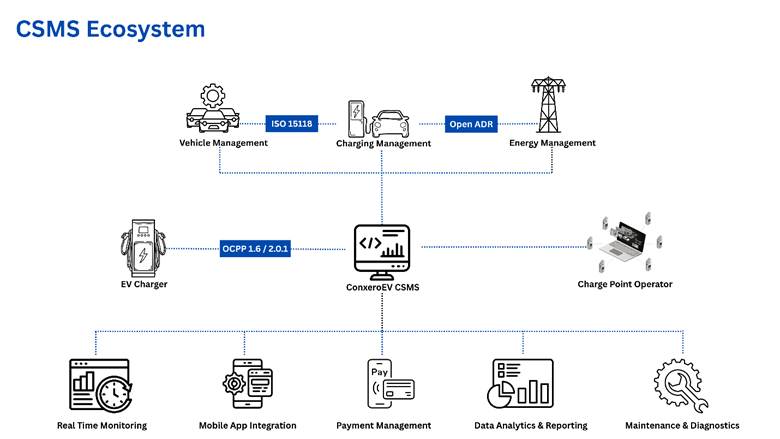
Here's a comprehensive look at the EV charging management software features.
Key Features:
- User Management:
- Access control in electric vehicle (EV) charging networks is critical for both security and user management. Fleet managers will want to restrict depot chargers to authorized drive-alone access, and residential property managers will need to manage who can plug in, when to plug in, and for how long. For this reason, a complete EV charging management platform should enable custom access permissions based on user groups such as residents, employees, or users of fleet vehicles, so the right users have access, at the right time. This should include secured access for authorized users via RFID cards, mobile apps, or some membership access.
- Real-Time Monitoring & Reporting:
- Assess the state of your charging network in real time with complete diagnostics and insights. Enable fault detection, firmware management, and ongoing optimization of your network. By monitoring proactively, you can ensure a more reliable network to maximize uptime. Move sustainability forward by measuring your EV charging network's impact on CO₂.
- Energy Management:
- Reduce the risk of grid overload and improve energy efficiency through intelligent network load management, enabling consistent interoperability with all aspects of your charging infrastructure, utility grid, and renewables, whilst allowing optimized energy distribution to all elements of your operation through demand response integration by OpenADR.
- Payment Management:
- Effortlessly connect with your desired payment gateway and manage multiple billing methods for customers and partners. You can set site-level pricing with peak and off-peak hours tracking, as well as create customized subscription plans with site-specific needs.
- Scalability & Network Expansion:
- Easily add new charging stations and new features to keep up with growing EV needs. Support multi-network interoperability, which allows users to access stations across networks.
- Remote Diagnostics & Firmware Updates
- In a scalable EV charging infrastructure, being able to operate remotely is no longer a nice-to-have, it is a necessity. The Charge Station Management System (CSMS) has enabled advanced remote diagnostics and firmware management functions, improved operational efficiency, system reliability, and service uptime
- Analytics & Reporting
- In an era driven by data, visibility into operations is vital. CSMS offers complete analytics and reporting capabilities that allow operators, site owners, and stakeholders to drive meaningful decisions while optimizing performance across the EV charging network.
ConxeroEV's Role in the Transformation
A cloud-agnostic digital platform for EV charging for its intended purpose of utilizing in-house accelerators and services. The platform consists of reusable functional assets that help its customers build: innovation, drive differentiation, and accelerate time-to-market.
ConxeroEV is acting as a change agent in the EV charging industry by providing a smart, interoperable, and cloud-native Charge Station Management System (CSMS).
Designed For: The CSMS caters to Charge Point Operators (CPOs), Fleet Managers, Home Charging & EV Charger Manufacturers, are designed to optimize charge station operations, dynamic pricing, and automated inspections for maximum uptime and efficiency.
Designed With: Standards including OCPP 1.6 ,2.0.1 & Open ADR, ConxeroEV gives operators the capabilities they need with features such as remote diagnostics, over-the-air firmware updates, live monitoring tools, intelligent tariff schemes and comprehensive analytics. ConxeroEV streamlines integration with all types of chargers and offers scalable, secure, and commercially advanced solutions to build an efficient, reliable, and future-proof charging network.
Learn more about ConxeroEV on:
Conclusion
To summarize, the dawn of electric mobility and the necessity to use intelligent software to plan and execute EV charging infrastructure, like CSMS, is here. The ConxeroEV platform is pioneering by linking hardware to passenger/usability experience while delivering seamless operations to increasingly develop smart, sustainable, commercially viable charging ecosystems. The ConxeroEV CSMS is shifting us to the next generation of electric mobility by leveraging remote diagnostics, real-time visibility, and robust interoperability.
Powering the future isn’t only about more power and better batteries, but about smart charging networks that are connected. That is where CSMS is paving the way.

Manish Gupta is a Business Analyst who has 3 years of experience aligning business requirements and effective technology solutions. He holds a Master's degree in Administration and is skilled in requirements analysis, process improvement, stakeholder engagement, project management, and data-driven decision-making in various industries.