
embedded world Product Showcase: ECS-DoT Ultra-Low-Power Edge AI SoC from EMASS
March 09, 2026
Sponsored Story
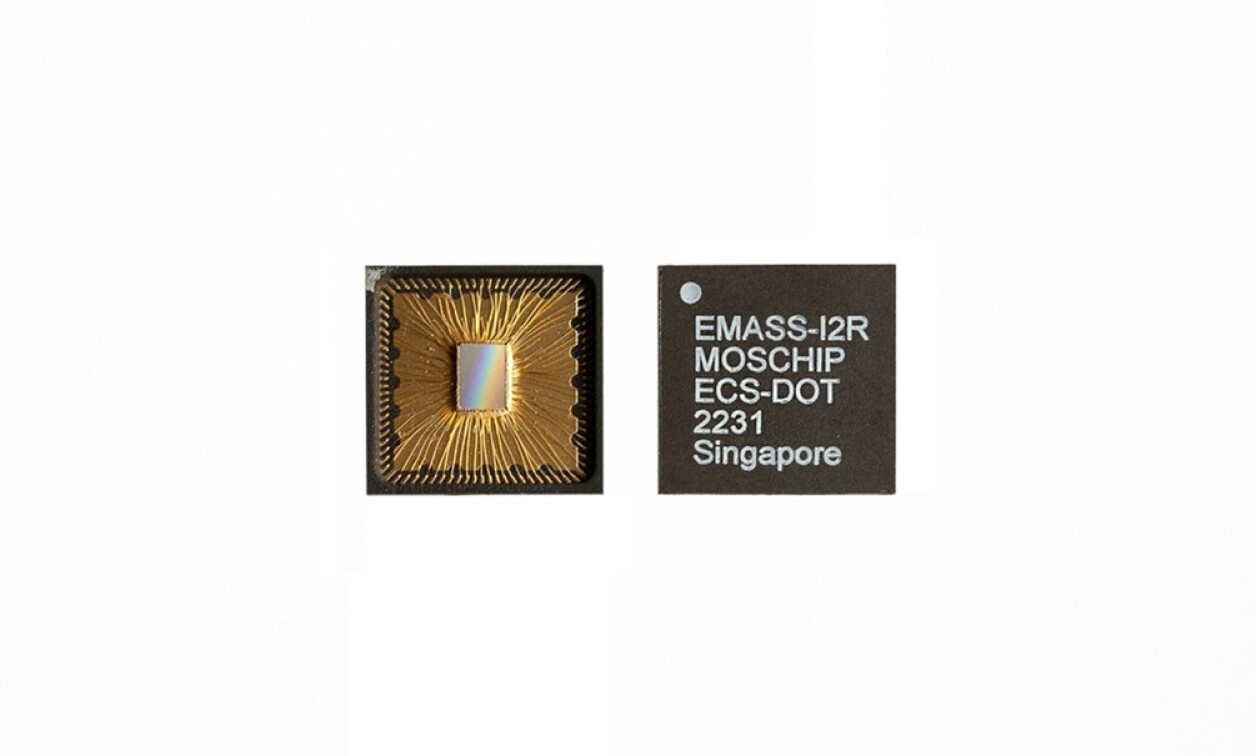
Modern edge AI applications are increasingly evolving. Devices such as hearables, wearables, AI cameras, and drones are being developed so that they no longer rely on centralized cloud AI, and instead can be supported by on-device AI that keeps data closer to the source, therefore improving latency, energy consumption, and bandwidth and connectivity limitations.
Designed to bring always-on intelligence to the sensor edge, improving the aforementioned features and more, is the ECS-DoT ultra-low-power, application-ready system-on-chip (SoC) from EMASS. The ECS-DoT supports real-time processing of sensor, voice, and vision data in compact, battery-powered devices in a 5mm x 5mm QFN package (88 pins).
The ECS-DoT SoC in Action
The physical size of the ECS-DoT SoC is designed with 22nm technology with a 7mm 2 die area. Leveraging the RISC-V architecture, the SoC enables power efficiency up to 12TOPs per Watt. The 32-bit RISC-V core with floating point support, and dual deep learning accelerators provide an AI compute of 30 GOPS at 5mW for ultra-low-power edge AI processing.
For memory, the SoC features 4MB on-chip memory, made up of 2MB of SRAM + 2MB of MRAM. For standard I/O, the solution supports I²C, I²S, UART, QSPI, CPI, and 32 GPIOs. Additionally, the ECS-DoT features built-in decompression IP at ~1.3 bits per weight.
Eliminating the previously mentioned cloud dependency, the SoC supports real-time equipment
health monitoring at the edge with on-device sensor data processing transmitted wirelessly via Semtech LoRaWAN. For hearables/wearables, it also leverages an Inertial Measurement Unit (IMU).
Getting Started with the ECS-DoT SoC
The ECS-DoT ultra-low-power SoC supports bare-metal or RTOS development with a full SDK and evaluation platform compatible with Caffe, PyTorch, TensorFlow Lite, and Edgelmpulse. ECS-DoT’s architecture is ideal for deployment across industries like wearables, drones, industrial IoT and robotics, smart devices, healthcare, and environmental sensors.
Additional Resources:
- Product page: https://nanoveu.com/emass/products/
- Press release: https://nanoveu.com/wp-content/uploads/2026/02/EMA017_Embedded-World-Release.pdf
- Whitepaper: https://nanoveu.com/wp-content/uploads/2025/11/EMASS-Whitepaper.ECS-DoT.11-25.pdf

Tiera Oliver is the assistant managing editor at Embedded Computing Design. She is responsible for web content editing, product news, and story development. She also manages, edits, and develops content for ECD podcasts, including Embedded Insiders.
She utilizes her expertise in journalism and content management to oversee editorial content, coordinate with editors, and ensure high-quality output across web, print, and multimedia platforms. She manages diverse projects, assists in the production of digital magazines, and hosts company podcasts by conducting in-depth interviews with industry leaders to deliver engaging and insightful discussions.
Tiera attended Northern Arizona University, where she received her bachelor's in journalism and political science. She was also a news reporter for the student-led newspaper, The Lumberjack.