How Synthetic DNA for Data Storage Could Help the Memory Crisis
May 01, 2026
Story
If you haven’t already heard, we’re in a memory crisis. More specifically, we’re in a global memory chip shortage, which began in late 2025 and is likely to persist into 2027, according to the International Data Corporation.
This shortage is caused by the exponential increase in high-performance AI models and the amount of data and subsequent data centers required to keep them running.
AI models come in a wide range of sizes, speeds, costs, and capabilities. There are small, lightweight AI models that run locally on devices for quick processing, such as AI assistants, and large, foundational models designed for powerful, long-form reasoning and coding use cases, such as code generation and analysis.
The challenge is that AI is hungry for memory, and regardless of how small the type of AI memory is, there are still billions of devices to feed. With both small and large models, there’s not just one that takes precedence over the other; they are both advancing and consuming at the same speed. This causes an increased need for DRAM, NAND flash, and HBM memory types, and even these have their limits.
Thanks to some leading-edge research in Biology, there might be a solution forthcoming.
Using Biology to Increase Capacity
Kavya S. Keremane is a postdoctoral researcher in materials science and engineering at Penn State. Her research background is in optoelectronics and photovoltaics, especially in energy storage and conversion, memory storage, and biomimetic sensing.
Keremane’s current research focus is on DNA semiconductor-based memory storage device development and fabrication, which can support the development of ultra-low power next-generation memory devices.
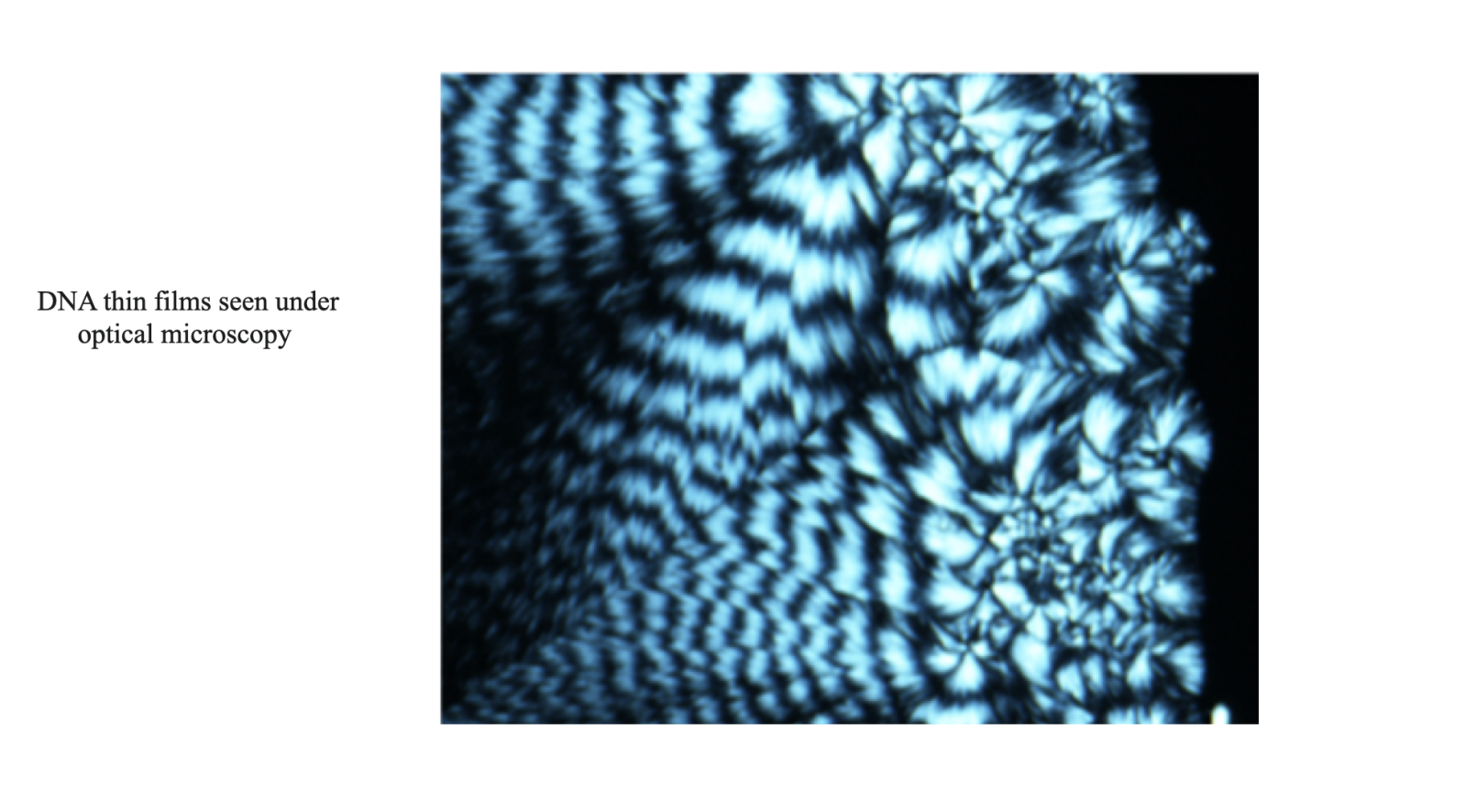
Most engineers are familiar with the traditional types of memory, like flash and DRAM, but Keremane’s research makes use of biological material that functions differently from the former silicon-based types.
“Synthetic DNA data storage is a technological process that uses artificially or customized synthetic DNA molecules where we can store the data or information. Traditionally, computers store information using bits, where each position can be either 0 or 1, so only one piece of information per position,” said Keremane. “In case of DNA, we have 4 nucleobases or four building blocks, that's called adenine, guanine, thymine, and cytosine. Because there are more choices, each position in DNA can hold more information than a single bit.”
This concept goes back to the human body and how all genetic information is stored in our DNA.
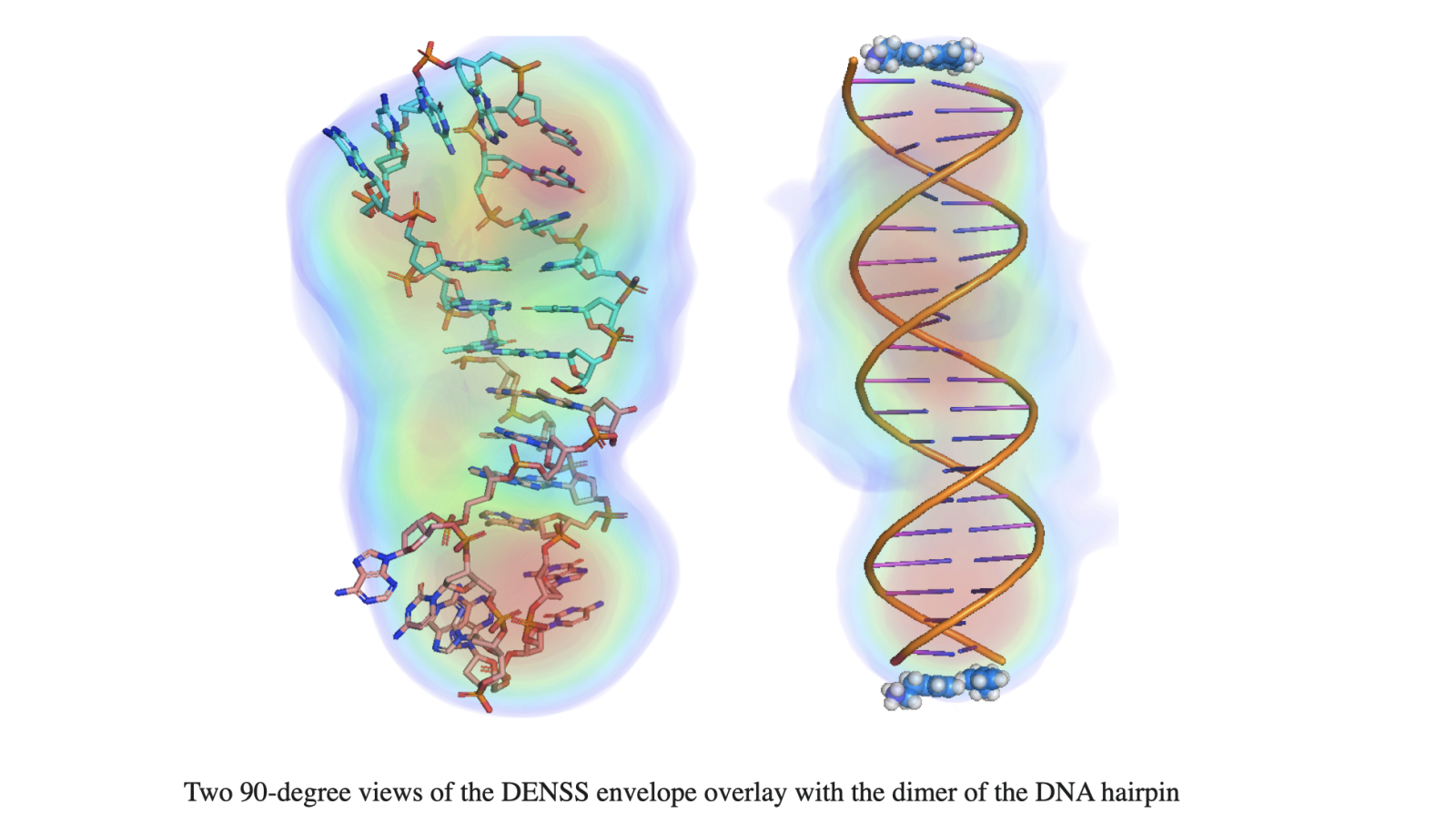
Most cells in the human body contain a nucleus, which houses genetic material, and the human genome has around 3.2 billion base pairs. This means that our bodies hold almost 1 gigabyte of information.
“So, DNA provides both a greater possibility for compression and orders of magnitude more physical density for data storage due to its molecular characteristics, and the fact that it is a 3D storage method,” explained Keremane.
Keremane works alongside Dr. Bed Poudel, a research professor of materials science and engineering at Penn State University, whose research focuses on energy materials.
Dr. Poudel said the challenges in current data storage technology, especially with AI chips, are energy consumption per process and storage density. He explained that the goal of their research is propelled by the demand for higher computing power and, therefore, the need to store more data. They’re working to support the need for higher data storage with lower energy.
According to Dr. Poudel, they are working to solve a “major problem with AI chips and computation…the more energy you consume, the chips get hotter. So, in this process, we are using a lot less energy, 100 times less…so that way, the thermal management problem would be a lot simpler. So, the data storage center, they can they can operate, let's say, more comfortably, right?”
The Biological Benefits and Challenges
In addition to addressing the challenges of energy consumption and thermal management, the hybrid DNA solution supports improved density and durability compared to existing silicon-based storage media.
In their research, Keremane and Dr. Poudel’s hybrid DNA, along with perovskites between platinum and silver, use a similar architecture to traditional commercial devices.
According to the Clean Energy Institute at the University of Washington, “A perovskite is a material that has the same crystal structure as the mineral calcium titanium oxide, the first-discovered perovskite crystal.”
The high-performance hybrid semiconductor material used in this research is made up of organic-inorganic halide perovskites (OIHPs), with the structure ABX3, where A is an organic cation, B is a metal (Pb, Sn), and X is a halide.
Keremane said, “In today’s engineered devices, like the DNA-perovskite memristors described in our paper, DNA is not used to store data as sequences but as a functional material within electronic components. It helps control charge transport and enables low-power, non-volatile memory operation....we can design the hardware which can mimic the biological neural networks to get a more efficient and more efficiency as well as speed in artificial intelligence tasks. So, these DNA-based data storage systems can lead to a long-term neuromorphic computing hardware solution, as well as some bio-integrated electronics.”
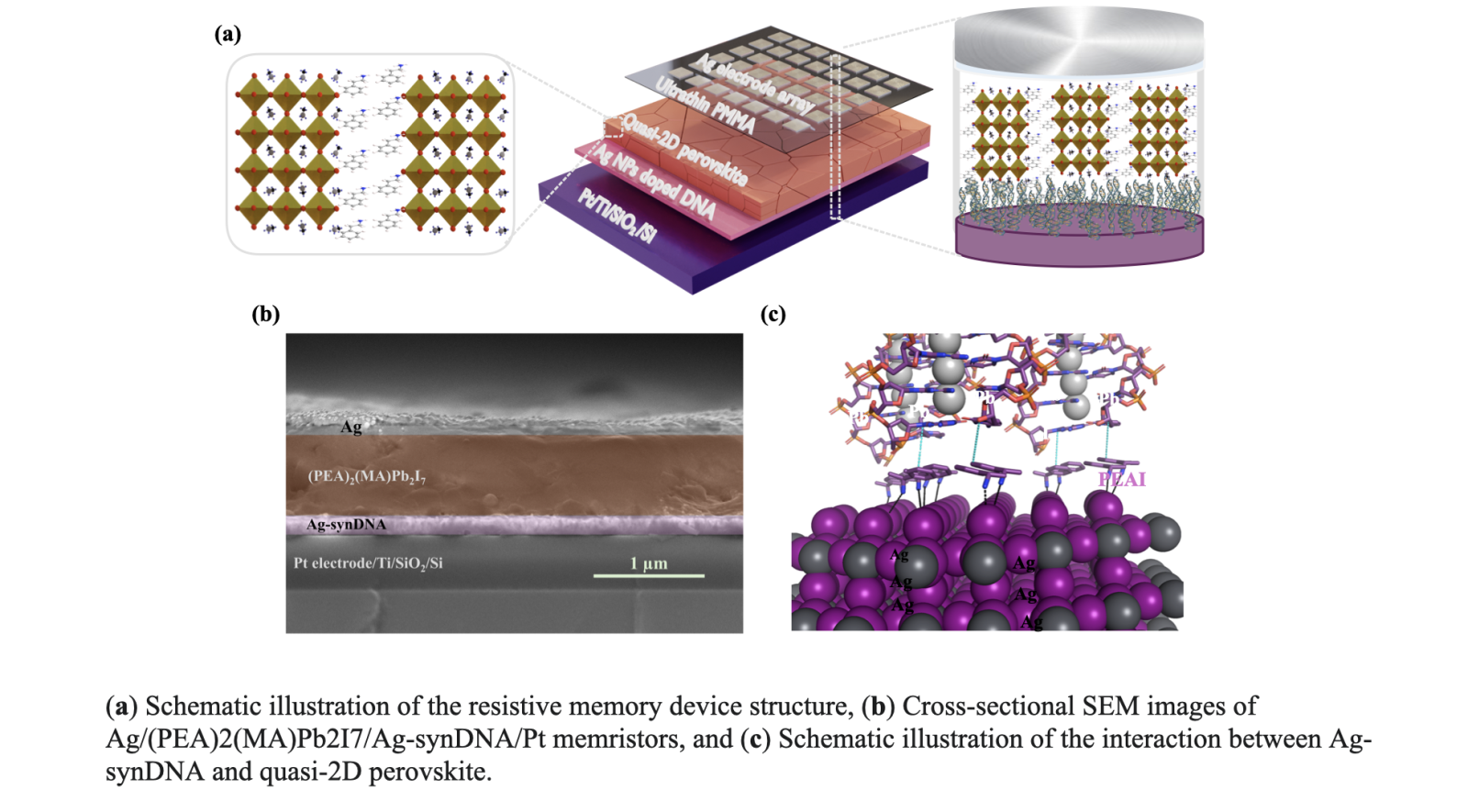
“They are crystals in the form of ABX3. That means we can combine different organic cations, inorganic cations, metal ions, and halides. And we can design their composition and play with different metal ions to reform the structure… we used two-dimensional perovskites here for our work, and these materials have excellent charge transport properties, ionic conductivity, and band gap can be used based on the compositions. And the performance mainly depends on the crystal quality and the compositions here,” explained Keremane.
But of course, a solution as innovative as this still has its challenges. Combining such delicate biological material with electronics that are often built to be durable for rugged environments presents integration issues because DNA is not compatible with existing semiconductor fabrication. DNA can degrade under high temperatures, which affects manufacturing.
Dr. Poudel said, “This technology is so drastically different from the existing technology… traditionally chips have been made in a certain way, but I think this is very different: nature-inspired, using DNA… the biggest thing is, right now this is the early stage, so there needs to be probably some resource and investment from the companies to adapt this process into their existing system. So that will be, I think, one of the main challenges before we see this into commercial product.”
The Future of DNA-Based Data Storage
Investment would be beneficial since the cost of current DNA synthesis is too expensive for large-scale data storage and manufacturing. DNA-based storage is still in the early stages of research, especially with the care that needs to go into the design and customization of products.
“As the demand for low-power data storage grows, especially with AI and data centers, there is strong motivation to develop these technologies further. In the future, if DNA storage becomes commercial and scalable, the cost is expected to come down,” said Keremane. “In the short term, we will likely see improved prototypes with better stability, endurance, and integration, especially in hybrid systems like DNA-semiconductor memristors, where molecular design is used to control electronic behavior more precisely.”
Dr. Poudel and Keremane said they have been in contact with companies to discuss how synthetic DNA can be made with chip-level integration. They’ll continue to move toward large proposals through the government to accelerate the process. They have already begun lab innovation, so what’s next is partnering with companies and governments to be able to introduce more viable prototypes and bring this vision to reality.
Keremane said, “For lower power consumption data storage and media, DNA data storage is an excellent option. There are many companies working commercially to customize the DNA and increase the slow writing speeds in data storage. So, it's in high demand right now. I think in five to 10 years, we can see a drastic change in improvement or progress in the DNA-based data storage media.”

Tiera Oliver is the assistant managing editor at Embedded Computing Design. She is responsible for web content editing, product news, and story development. She also manages, edits, and develops content for ECD podcasts, including Embedded Insiders.
She utilizes her expertise in journalism and content management to oversee editorial content, coordinate with editors, and ensure high-quality output across web, print, and multimedia platforms. She manages diverse projects, assists in the production of digital magazines, and hosts company podcasts by conducting in-depth interviews with industry leaders to deliver engaging and insightful discussions.
Tiera attended Northern Arizona University, where she received her bachelor's in journalism and political science. She was also a news reporter for the student-led newspaper, The Lumberjack.