
Vecow Powers AI-Enabled Urban Management
November 07, 2025
Sponsored Story

Vecow leverages high-precision RTK (Real-Time Kinematic) GPS technology to deliver centimeter-level positioning accuracy for demanding navigation tasks in urban environments.
To meet the client's specific maintenance requirements, we designed a custom-fit mounting system for the onboard computer to optimize accessibility and reduce downtime during routine maintenance and system upgrades.
Artificial intelligence (AI) is increasingly being deployed in public safety and urban management to help cities achieve safety, sustainability, and resilience goals. By analyzing large volumes of real-time data from cameras, sensors, and connected infrastructure, AI enables faster detection of incidents and more efficient response. For example, AI-powered video analytics can identify unusual crowd behavior, detect accidents, or recognize hazards, helping emergency services react before situations escalate. Predictive analytics are also used to forecast crime hotspots or traffic congestion, allowing authorities to allocate resources proactively.
Beyond safety, AI contributes to sustainability by optimizing traffic flow to reduce fuel consumption and emissions, managing energy use in public spaces, and monitoring environmental conditions such as air quality. This data-driven management helps cities make smarter infrastructure decisions and align with global climate targets and mandates.
Resilience is strengthened through AI’s ability to support disaster preparedness and recovery. Systems can model the impact of floods, wildfires, or extreme weather, while real-time alerts enhance coordination during crises. In addition, AI-enabled communication tools provide citizens with timely guidance and updates.
In the past, achieving AI-driven public safety and urban management was limited by technology, infrastructure, and data challenges. For example, cities lacked the sensor networks, connectivity, and computing power required to collect and analyze data, and certainly not in real time. And the AI algorithms were not mature enough to reliably detect patterns or make predictions from complex urban data. And concerns about cost, privacy, and public trust slowed adoption.
AI For Self-Healing Cities
The vision of self-healing urban systems is rooted in the seamless integration of vehicles, drones, and autonomous infrastructure with AI-powered analytics. By embedding intelligence directly into its daily operations, a city can shift from reactive management to proactive and adaptive governance.
Connected vehicles, for example, can share real-time traffic and safety data to reduce congestion and accidents, while drones can be deployed for rapid incident assessment, infrastructure inspection, or emergency deliveries. Autonomous infrastructure, such as smart grids, adaptive traffic lights, and resilient water systems, can detect anomalies and automatically correct faults before disruptions occur. Such an approach not only enhances safety and efficiency but also unlocks value at various stages of a city’s digital transformation.
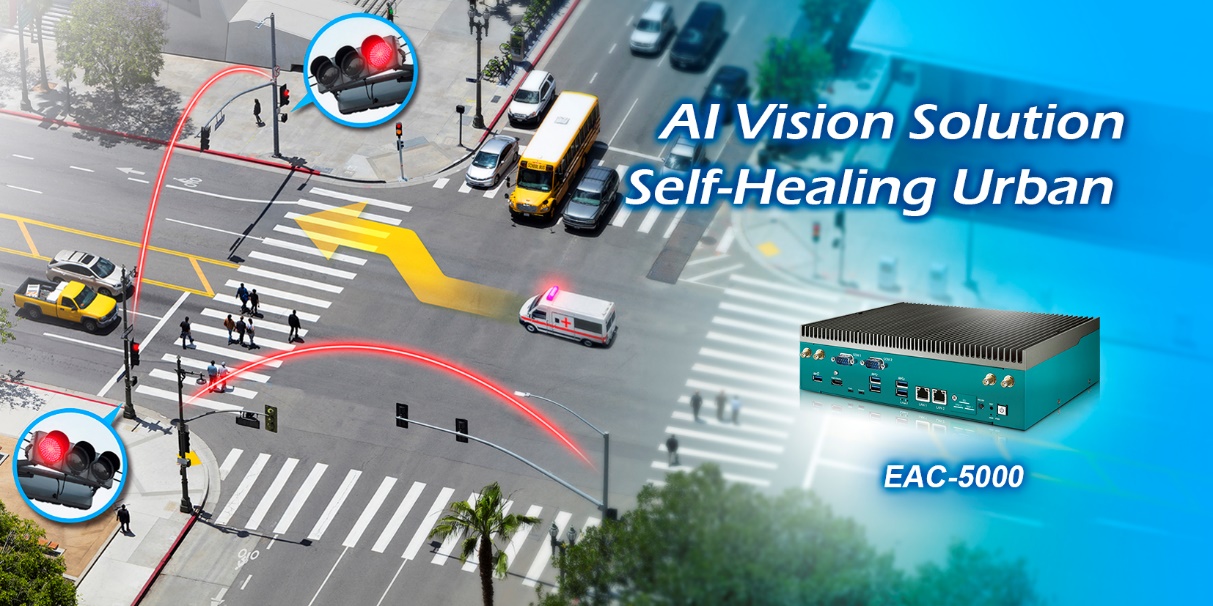
Urban/city management is a key application for Vecow’s EAC-5000 embedded AI computing system, which is powered by NVIDIA® Jetson AGX Orin™ platform.
AI In Action
As a quick backgrounder,
At the core of Vecow’s customer approach is the creation of a virtual data layer that unifies disparate data sources into a seamless, centralized access point. This data layer eliminates the inefficiencies of physically replicating or moving data across potentially siloed systems. Instead, the analytics platform can interact with the aggregated real-time data as though it originated from a single integrated source. Vecow’s Edge AI Computing System was the enabler, offering the compute density, low latency, and reliability necessary to process and deliver massive volumes of video and sensor data directly at the Edge.
The technology described here has been successfully deployed in both New York City and Abu Dhabi, where digital
It should also be noted that durability and industrial-grade design were key design criteria for the customer. Urban deployments often involve harsh environments, such as outdoor enclosures, high traffic areas, and variable weather conditions. Vecow’s Edge AI Computing System provided the ruggedness and reliability needed to ensure uninterrupted performance in all of these conditions.
The customer’s end product, powered by Vecow technology, evolved into a robust urban operations platform. By converging AI vision, digital twin simulations, and real-time data unification, the system allowed municipalities to not only respond to urban challenges but also to anticipate and prevent them. In doing so, Vecow’s customer has redefined how cities manage infrastructure and services, setting a new standard for precision, efficiency, and foresight into urban management. Vecow leverages high-precision RTK (real-time kinematic) GPS technology to deliver centimeter-level positioning accuracy for demanding navigation tasks in urban environments. That includes a customized mounting assembly for the onboard computer to optimize accessibility and reduce downtime during routine maintenance and system upgrades.
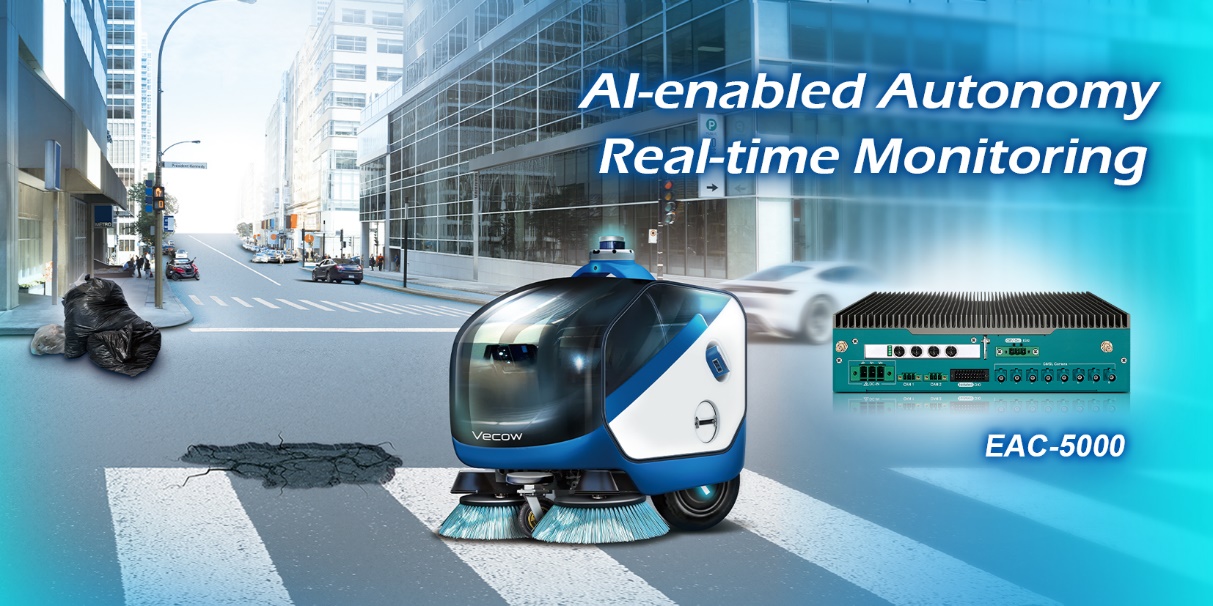
The Vecow ESC-5000 serves as the backbone of a remote-monitoring system. It can ably handle this application thanks to its plethora of I/O and advanced compute capabilities.
Other technologies that needed to be integrated for a complete solution include support for multiple vision systems, non-stop 5G communications, and GPS. And because this is a relatively new field for everyone involved, there is some level of uncertainty involved. An experienced partner like Vecow can be invaluable.
Vecow at the Core
The actual Vecow hardware platform that was deployed in these systems is the Vecow EAC-5000 with the
Equipped with non-stop 5G communication and GPS, the EAC-5000-R64 ensures uninterrupted data exchange between Edge devices and centralized platforms, a key requirement for time-sensitive applications like smart traffic control and predictive infrastructure management. This continuous connectivity enhances the accuracy and responsiveness of digital twin models, enabling cities to optimize service delivery with real-time insights.
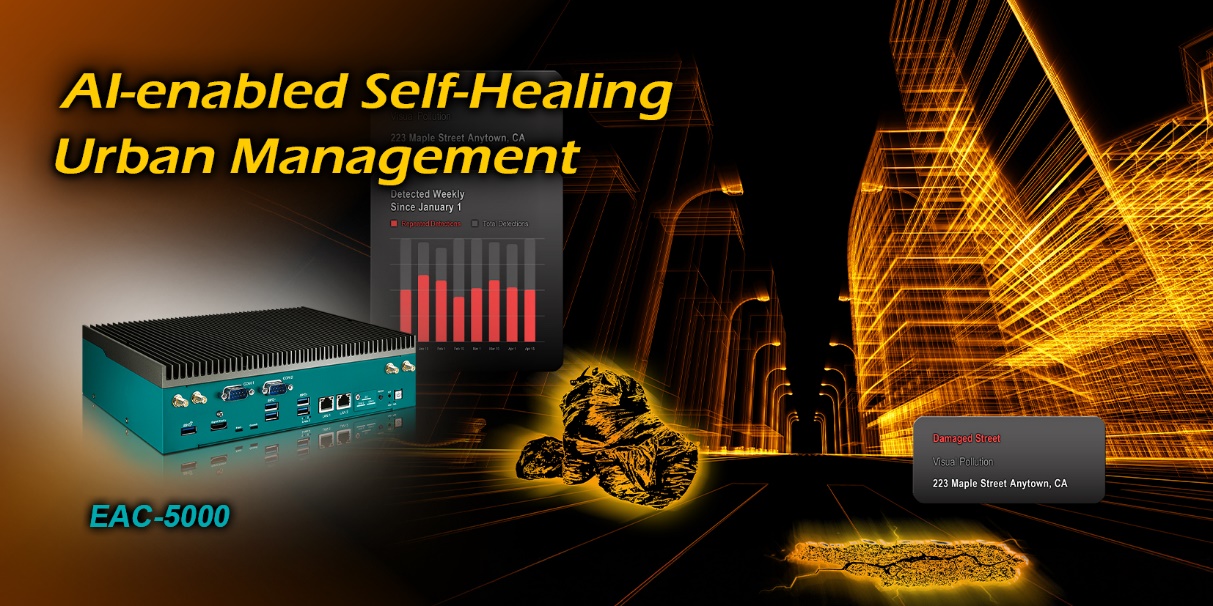
The EAC-5000 delivers outstanding system performance, leveraging machine vision technology to handle real-time urban maintenance tasks.
Designed for demanding environments, the system’s compact, fanless chassis (260 by 182 by 69 mm) absorbs shock and vibration while maintaining reliable performance. Its wide operating temperature range of -25°C to 70°C makes it suitable for deployment in outdoor urban infrastructures, roadside cabinets, or vehicles. Together, these features ensure durability and resilience in the unpredictable conditions of modern city environments.
By now, you can see that Vecow has the products and technologies to handle the toughest urban management applications. To reiterate, the company provides ruggedized, AI-optimized computing platforms that are purpose-built for the extreme demands of this environment. In addition, Vecow has the experience and expertise to handle your design questions and issues. For more information, access the Vecow NVIDIA Jetson Solution page or contact the company directly.