Your Distributors Sell What's Easy. AI Just Made Your Parts the Easy Choice
July 22, 2026
Blog

The mass-market support gap has been around about as long as the industry has. Distributor FAEs, dedicated account teams, more training every year: all of it helped and none of it closed the gap. AI is the first thing I've seen that actually can.
A big chunk of your revenue comes from customers you will never meet, sold to by distributor reps who are carrying tens of thousands of parts from dozens of suppliers and cannot possibly get to yours in time to win the socket.
These aren't people who lack technical ability. The problem is closer to arithmetic. To sell your parts properly a rep would need to know all of them, know how each one stacks up against the competition, and know where they land in applications that run from factory floors to smart doorbells, and there are only so many hours in anyone's week. Even the specialists you pay to close that gap, the distributor FAEs and the mass-market account managers, hit the same wall: there are never enough of them, and never enough time.
Everyone in semiconductors knows this. It is one of the oldest and most stubborn problems we have, and the reason it never goes away is that every sensible fix only ever gets you partway.
I lived this at NXP. You end up running two businesses that barely resemble each other. Your strategic accounts get the whole setup, a named FAE, an account manager, an escalation path that exists specifically so someone can drop what they are doing and answer them, because the revenue on the table justifies all of it. Then there is the mass market: thousands of customers you have never spoken to, buying through Arrow and Avnet and Future and Digi-Key, each one ordering a hundred thousand units here or filling a single design slot there. On their own they look like rounding errors. Add them up and for a lot of broad-line companies they are half the business or more, and they get served with whatever attention happens to be left over.
Every design-in is an annuity, including the ones you lose
In most businesses a lost sale is just a lost sale and you move on to the next one. Semiconductors do not work like that. Win a design-in and you have not booked an order, you have booked a stream of them that can keep running for the better part of a decade. The flip side is the part people forget: a socket you lose is not a bad quarter you recover from, it is ten years of somebody else's revenue that got decided in a meeting you were never invited to.
And most of those meetings happen well out of your sight. In the mass market there are thousands of design decisions a year and you are in the room for almost none of them. Some engineer at a company you would not recognize has your part open in one tab and two competitors in the others, a deadline on Friday, and whatever answers he can dig up before then. The comparison nobody had time to write, the question that sat in an inbox for three days, the teardown that would have taken a month: each one is a socket handed to whoever replied first. Nothing about it feels like a loss when it happens, which is exactly the trouble with it. You cannot mourn a deal you never knew you were in.
You have already thrown money at this
The industry has hardly been sitting on its hands here. You train up distributor FAEs to push technical reach out into the channel. You hire mass-market account managers so that somebody is at least keeping half an eye on the smaller customers. You stand up product marketing teams whose entire job is to package and position each family for a market that runs from industrial to consumer and everything in between.
All reasonable, and all of it eventually runs into the same wall. However good your distributor FAE is, no one can be an expert on a hundred-plus product lines. As soon as a question falls outside their expertise, it joins the queue for the one person who has the answer. The account manager responsible for fifty customers is triaging priorities rather than diving deep into any single account. Product marketing, the team creating the slides - competitive comparisons, and sales enablement materials - is permanently playing catch-up. New products keep launching, each one requiring its own enablement before the channel can confidently sell it, and by the time that material is ready, the next launch is already waiting.
Underneath the headcount problem there is a worse one that hiring does not touch. Your distributor sells more than your line. The rep has your parts and your competitors' parts in the same bag, and a contract or a line-card slot does nothing to change what happens when a customer is actually on the phone. A rep chasing quota reaches for whatever is easiest to move. The part that already has a slide. The one where someone already worked out the competitive story and the block-diagram swap. It has nothing to do with loyalty. The quota rewards speed, and the fast part is the one that's already sitting there ready.
So the mass-market socket does not get won in your datasheet. It gets won in the half second where the rep decides what to put in front of the customer, and for as long as being that ready answer meant paying scarce human experts to build it, it was never going to be your part by default. The easy parts won. Everything else waited.
That is the piece that just came loose.
What AI does, and what it doesn't
Not a chatbot glued to your homepage. What I mean is taking the material you have already paid to produce, the datasheets and app notes and reference designs sitting on your own servers, and building something that answers the channel the way your sharpest product marketer would if she could somehow be on every call at once, cited, in seconds, at two in the morning, in languages you never hired for.
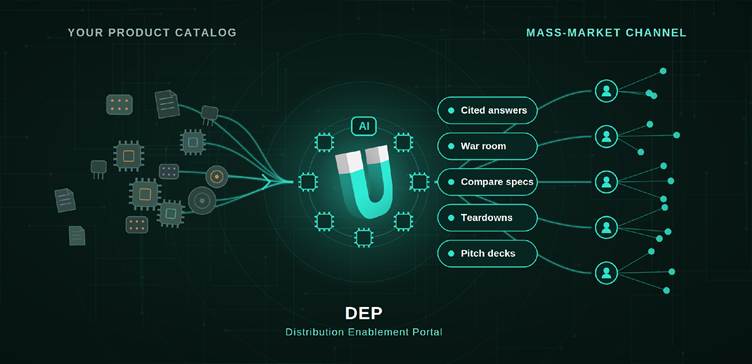
That is what we have been building at Understand Tech. We call it DEP, for Distribution Enablement Portal, and we built it alongside large semiconductor companies, Synaptics among them. For a rep or a channel FAE heading into an opportunity, it does a handful of things:
- Answers any technical question about your portfolio on the spot, with sources, which quietly makes most of the level-one and level-two questions that used to land on your engineers just disappear.
- Briefs them before the meeting on who the customer actually is, what they build, and where you fit.
- Generates the slides for that specific rep, customer and meeting. Someone types "I've got a customer building a Matter smart-home camera" and the deck is waiting before the call. Not a template with the logo swapped.
- Builds the competitive case, your part against theirs, with the argument for why yours wins already attached.
- Takes a design built around a competitor's chip and tells you which of your parts drops in where, and why.
The teardown that used to eat a month
Say a distributor wants to go after a socket inside something already on the market, a wall charger, a thermostat, whatever it happens to be. Before anyone can pitch, somebody has to work out what is inside the thing, down to which MCU and which Wi-Fi part and which power IC, and who makes each of them. The old way of finding that out ran through FCC filings and reverse engineering and a lot of squinting at boards, and it could quietly swallow a month of a good product marketer's life.
Now someone types in the product name, waits about two minutes, and out comes the whole thing: every significant component, its supplier, and a plan for how you take that socket with your own silicon. A customer of ours started calling it the virtual product marketer and it stuck, because that is exactly the colleague you used to email and then wait two days to hear back from, except this one never sleeps and it is answering a few thousand people at the same time.
The demand was always there. Answering it was the expensive part. Get the cost of an answer down to almost nothing and the long tail quietly stops being a thing you subsidize and turns into a thing that grows the business.
What it does to your P&L, and to your competitor's
Three things move at once. The design-ins you were bleeding start to stick, and that is not saved cost, it is new annuity revenue that simply was not landing before. The channel starts leaning your way, because now the part that is easiest to sell, the one with the instant answer and the finished deck, is yours, and you have captured something a good deal more durable than a rep's goodwill, which is their path of least resistance. And the experts you could never clone get their hours back for the large strategic deals that genuinely do need a human in the room.
Why this is urgent, not a roadmap item for next year
Design-ins compound, so being early here is not a nice-to-have, it is most of the whole advantage. Close this gap in the next year to eighteen months and you lock in sockets your competitors will not be able to pry loose until the next design cycle comes back around, and the thing keeps getting sharper the more your people lean on it. There is also a door here that only swings one way. Once a rep has lived with instant sourced answers, a two-minute teardown and a finished deck before the meeting, going back to waiting on an FAE callback becomes unthinkable, and before long that is simply what they expect from everyone on the line card. Give it to them and you are the easy line to sell. Fail to, and you get shaved off a rep at a time, a deal at a time, and the missing share only turns up much later, buried in a number nobody can quite account for.
So, somewhere concrete to start. Pick the competitor design you would most love to knock out, and we will pull the full teardown and the plan to win the socket while you watch, in roughly two minutes. DEP is in private preview right now. If you carry a P&L and you have ever quietly wondered what that long tail is really worth to you, that is the conversation I would like to have. I am easy to find on LinkedIn (Naama Bak), and DEP lives at understand.tech/product/apps/dep.
The companies that move on this first are not going to end up merely supporting the long tail a little better than the next vendor. They are going to take it, socket by socket, and keep it for a decade.
Hear the full conversation. Naama Bak sat down with host Ken Briodagh on the Embedded Insiders podcast (Embedded Computing Design) to talk through how DEP helps semiconductor channels win design-ins faster. Listen to the episode on Spotify.

Naama BAK is an entrepreneur with 15 years of experience in tech. He is the founder of Understand Tech, a generative AI platform for enterprises, and Trustii.io, a machine learning platform for data science challenges. He previously held roles at NXP Semiconductors, Orange, and Safran, working in cybersecurity across research, development, product marketing, and business development. He holds a Computer Science Engineering degree and an MBA.