
iOmniscient Partners with Intel for Lightweight Predictive Maintenance
December 11, 2025
Blog
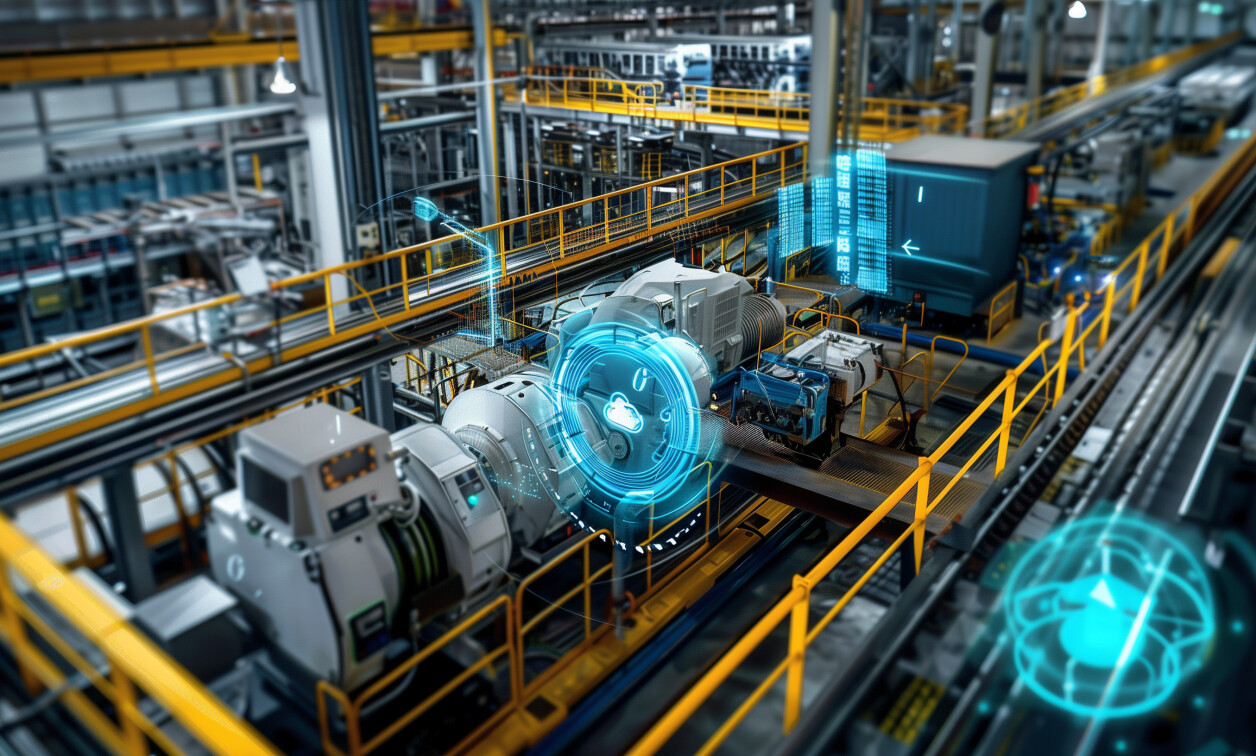
One of the toughest challenges with solving predictive maintenance, enabled by AI, is that there is usually no data available for training the system. Modern equipment may not break down for 5 years or more so there is insufficient data when the product is first launched on when and how it will break down. But AI systems using traditional methods such as Deep Learning can only operate when sufficiently large volumes of data are available for training the system and hence, they are incapable of addressing this problem.
But humans use much more complex ways of thinking and understanding their environment and iOmniscient has developed an AI capability that harnesses these other methods that humans use to develop a methodology called IntuitiveAI which can operate even when there is insufficient data to train a traditional AI model.
This IntuitiveAI can predict when equipment will breakdown even when there is very limited data. And as very little data is required for training the system, no GPUs are required and the system can be run on very cost-effective Intel Edge computers.
iOmniscient’s IntuitiveAI understands the maintenance status of complex objects or systems. by assessing it continuously and monitoring it for indicators that may necessitate preventive maintenance.
The iOmniscient predictive maintenance solution is targeted at manufacturing, robotics, and transportation, but can be applicable to many industries. With its multi-sensory AI capabilities, it’s designed to detect and predict equipment failure, resulting in a multi-fold increase in the productivity of maintenance staff as demonstrated by systems already implemented by the company.
iOmniscient emphasizes the solution leverages its proprietary Intuitive AI methodology to detect early signs of equipment failure without relying on deep learning or GPUs. The system analyzes multisensory inputs such as video, sound, and odors and uses the information it receives about overheating, wear, leaks, vibrations, and smell to predict when diverse assets such as pumps, motors, conveyor belts, robotic arms, and many others may break down.
Designed with lightweight architecture and a QUICK Training engine, the solution requires only minimal data, backed by iOmniscient. Only 5-10 samples of data of the equipment operating properly are needed to build effective models, which enable rapid deployment and cost efficiency. The system is optimized for Intel Core processors and Intel Xeon servers, so it can deliver scalable, real-time fault detection with reduced power consumption and bandwidth usage.
Thanks to the power of Intel Core processors and Xeon servers, iOmniscient asserts its predictive maintenance system enables:
- Real-Time Detection with high-performance CPUs for instant fault identification
- Multi-Sensor Fusion supported by scalable compute for complex data processing
- Low-Power Operation using efficient CPU architecture to reduce energy demands
- Rapid Model Training accelerated by evolving Intel CPU capabilities
This feature set makes this system ideal for industrial environments seeking smarter, sustainable operations, iOmniscient says.
Equipment maintenance and the maintenance of facilities is critically important for any organization, and downtime is always expensive. Equipment failure through poor maintenance results in incredible and unnecessary costs and also generates safety concerns. Meanwhile, reactive maintenance can be expensive and labor intensive. That’s why a lightweight, AI-powered predictive maintenance solution is the right answer to safer, more efficient, and more productive facilities.
Intel’s Edge AI Initiative
This blog is part of a series outlining Intel’s AI Edge initiative. Intel recently unveiled its Intel AI Edge Systems, Edge AI Suites and Open Edge Platform. These are designed to help partners to integrate AI into existing infrastructure and help them to jumpstart development and to increase trust in their system performance and security.
Intel is working together with its software partners in the creation and optimization of AI for edge applications, as illustrated by this series of blog posts. Intel is working with its hardware platforms to specify AI Edge systems that allow for best-fit AI performance for key AI edge workloads and are available in a variety of power levels, sizes, and performance options.
To find out more, click here to visit Intel.

Ken Briodagh is a writer and editor with two decades of experience under his belt. He is in love with technology and if he had his druthers, he would beta test everything from shoe phones to flying cars.
At Embedded Computing Design, he covers, AI, Edge Computing, Data Centers, Automotive, Industrial, Smart City, IoT and IIoT, Semiconductors, Healthcare, and lots more. He hosts weekly programs on YouTube, including the technology unboxing feature DevKit Weekly, and his news show ICYMI, and, along with Tiera Oliver, hosts the Embedded Insiders and Embedded Executive podcasts.
In previous lives, he’s been a short order cook, telemarketer, medical supply technician, mover of the bodies at a funeral home, pirate, poet, partial alliterist, parent, partner and pretender to various thrones. Most of his exploits are either exaggerated or blatantly false.
Muck Rack: https://muckrack.com/ken-briodagh
Industry Moderator: https://www.microelectronicsus.com/speakers/ken-briodagh-1
Apple Podcasts: https://podcasts.apple.com/us/podcast/embedded-insiders/id1359230366
Spotify: https://open.spotify.com/show/5X07QpW7U2CM9ZbGxl4p40