ISO 8800 Is Coming to Your Next Platform Program — Are You Ready?
March 30, 2026
Blog
For the past decade, ISO 26262 has been the governing framework for functional safety in road vehicles. It established how automotive engineers think about hazard analysis, safety goals, ASIL decomposition, and the lifecycle of safety-critical systems. It is now deeply embedded in how semiconductor IP vendors, Tier 1 suppliers, and OEMs design and certify their products.
But a new chapter has opened. ISO 8800, the standard governing the safety of artificial intelligence and machine learning systems in road vehicles, published in late 2024. It does not replace ISO 26262 — it extends it into territory the original standard was never designed to cover. And most engineering teams are only beginning to understand what that actually means for their next platform program.
Why ISO 26262 Was Never Enough for AI
ISO 26262 was built on a fundamental assumption: that safety-critical software behaves deterministically. Given the same inputs, a correctly implemented function produces the same outputs. Safety cases are built on this predictability — fault trees, FMEA, diagnostic coverage metrics, and ASIL decomposition all rely on the ability to reason systematically about failure modes.
Machine learning models break this assumption. A neural network trained to recognize pedestrians does not fail in the ways a classical algorithm fails. Its behavior is shaped by training data, distribution shifts, edge cases that were never seen during development, and emergent patterns that no engineer explicitly programmed. There is no source code to audit in the traditional sense. Fault injection and diagnostic coverage calculations do not translate cleanly.
As AI-based perception, decision-making, and control systems move from driver assistance features into safety-critical vehicle functions, the gap between what ISO 26262 requires and what these systems actually need has become impossible to ignore. ISO 8800 is the industry's response to that gap.
What ISO 8800 Actually Adds
ISO 8800 introduces a framework specifically designed for AI/ML elements in safety-related vehicle systems. Rather than replacing the hazard analysis and risk assessment process of ISO 26262, it adds a parallel layer of requirements that address the unique characteristics of learned behavior.
Several areas represent genuinely new ground for most engineering teams. The standard requires explicit documentation and management of the Operational Design Domain — the conditions under which an AI element is expected to operate safely. This is not the same as a traditional requirements specification. It demands that teams define the boundaries of safe operation in terms of environmental conditions, sensor limitations, and real-world scenarios, and then demonstrate that those boundaries are enforced at runtime.
ISO 8800 also introduces requirements around data management that have no direct equivalent in ISO 26262. Training data quality, data provenance, and the processes used to validate that a model generalizes correctly beyond its training distribution all become part of the safety argument. For organizations accustomed to hardware-centric safety cases, this represents a significant shift in how evidence is gathered and presented.
Perhaps most significantly, ISO 8800 requires what might be called a "safety performance" argument — evidence not just that a system was designed correctly, but that it actually behaves safely across a representative range of real-world conditions. This moves certification closer to empirical validation than deterministic proof, which challenges deeply held assumptions about how automotive safety evidence is structured.
Where the Two Standards Interact
ISO 8800 does not operate in isolation. In most real architectures, an AI/ML element sits within a larger system that also contains safety functions governed by ISO 26262. A perception model feeds into a control system. An ADAS decision layer interacts with a braking ECU. The boundary between what ISO 8800 governs and what ISO 26262 governs runs through the middle of the system design.
Managing this interface is one of the most challenging practical problems teams will face. Safety goals and assumptions established under ISO 26262 must remain consistent with the operational boundaries defined under ISO 8800. The safety case for the overall system has to coherently address both frameworks, and the evidence required by each does not always map neatly onto the same development artifacts.
Semiconductor IP vendors occupy a particularly interesting position in this landscape. Processor IP that supports safety-critical AI inference workloads may need to satisfy requirements from both standards simultaneously — ASIL-D diagnostic coverage requirements from ISO 26262 alongside runtime monitoring and ODD enforcement requirements implied by ISO 8800. This dual responsibility is still being worked out across the industry, and standards bodies, including IEEE, are actively developing supporting frameworks to help resolve it.
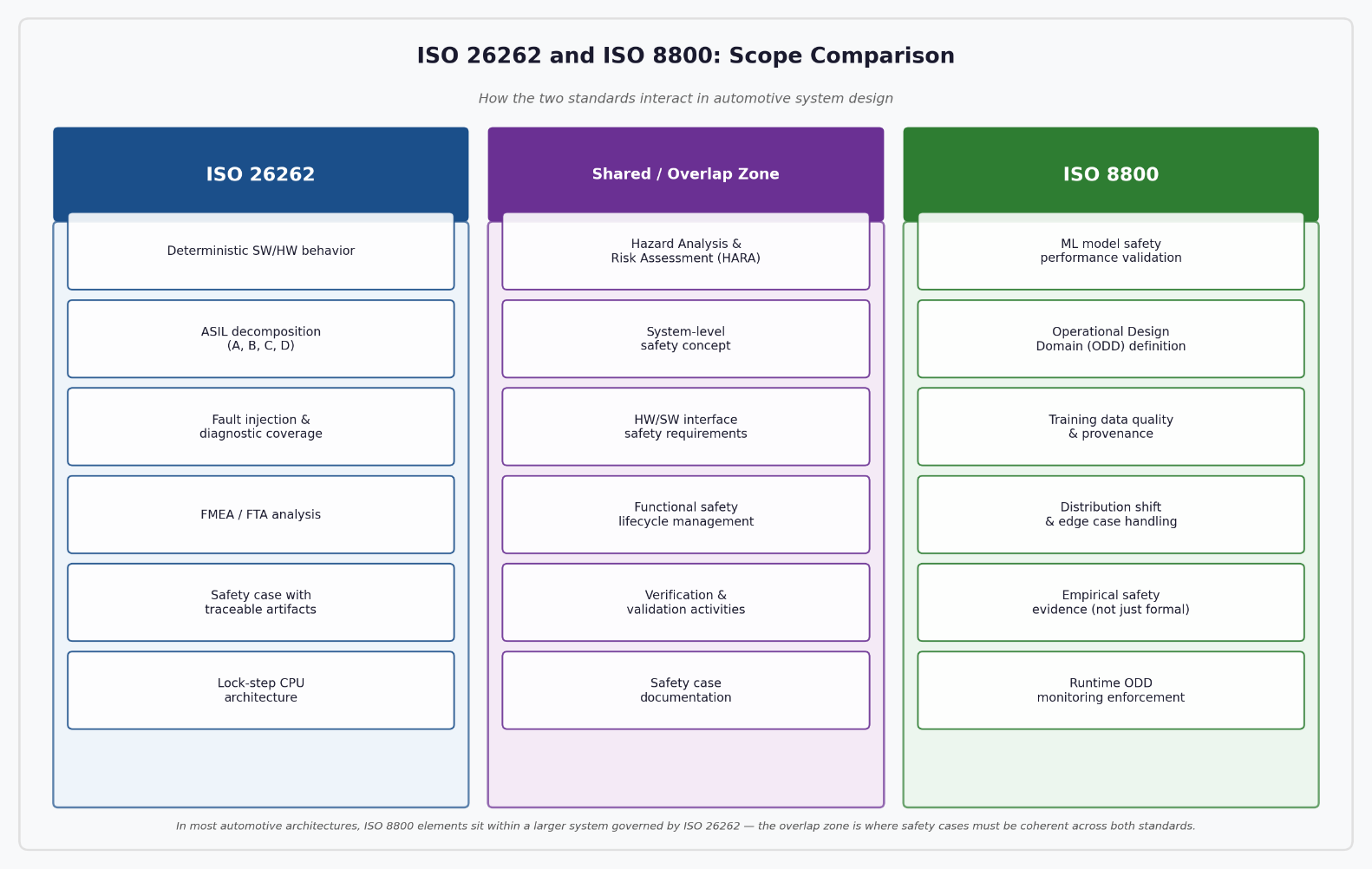
Figure 1:ISO 26262 vs ISO 8800 — with an overlap zone
Figure 1 represents ISO 26262 and ISO 8800 Scope Comparison — how the two standards interact in automotive system design
What Engineering Teams Should Start Doing Now
ISO 8800 is not a distant concern. Vehicle programs launching in 2027 and 2028 that include AI-based safety functions are already in their architecture phase today. The decisions being made now — about system decomposition, safety concept structure, and the allocation of safety requirements to hardware and software elements — will determine how tractable ISO 8800 compliance is later.
Teams that wait until the software development phase to engage with ISO 8800 will find themselves retrofitting safety arguments onto architectures that were not designed to support them. The standard's requirements around ODD definition, data management, and safety performance validation are not features that can be added late — they need to be designed in from the start.
The most important first step is to map where AI/ML elements exist in your system and where the boundary between ISO 8800 scope and ISO 26262 scope runs. From there, the safety concept needs to be extended to address both frameworks coherently, and the evidence plan needs to account for the empirical validation work that ISO 8800 requires in addition to the deterministic analysis that ISO 26262 demands.
The Bigger Picture
ISO 8800 represents something larger than a new compliance checkbox. It reflects a fundamental evolution in what the automotive industry is asking safety engineers to do. The field has always required rigorous reasoning about failure — but it has traditionally done so through the lens of deterministic systems, explicit specifications, and traceable design decisions.
AI changes the nature of that challenge. It asks safety engineers to reason about systems whose behavior is emergent, whose failure modes are statistical rather than categorical, and whose safety argument must be grounded in empirical evidence as much as formal analysis. ISO 8800 is the industry's first attempt to build a rigorous framework around that challenge.
Engineers who understand both the traditional functional safety world and the new requirements ISO 8800 introduces will be in short supply — and high demand — for years to come.
The views and opinions expressed here are the author’s own and do not necessarily reflect the official policy, position, or perspective of any associated companies, organizations, or governing bodies.
Sandeep Kumar Bomthapalli is a Senior Staff Functional Safety Architect specializing in safety-critical automotive semiconductor design.

Sandeep Kumar Bomthapalli is a Senior Staff Functional Safety Architect specializing in safety-critical automotive semiconductor design. At Synopsys Inc., he leads ASIL-D safety architecture and certification for RISC-V processor IP targeting automotive SoC applications under ISO 26262 and ISO 8800. Prior to Synopsys, Sandeep led functional safety SoC architecture at NXP Semiconductors for automotive platforms in production across global OEMs.