The Open AD Kit Blueprint is Accelerating SDV Development Across the Industry
December 09, 2025
Story
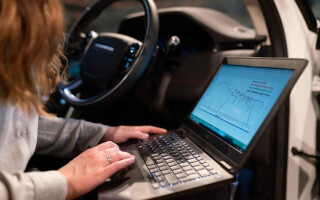
Autonomous vehicle capability has been advancing in the open for more than a decade, and now it sits at the center of the shift toward AI-defined vehicles.
The industry is evolving beyond early SDV concepts and into a phase where teams need to build, iterate, and scale autonomy software faster. Platforms must support high performance AI workloads, consolidate functions efficiently, and run consistently across cloud and vehicle environments.
SOAFEE and other open initiatives are enabling this shift by providing shared foundations that remove friction across the development stack. Other sectors have already proven that open, software-first architectures accelerate progress. The automotive industry is following the same trajectory as more of the SDV and autonomy stack becomes recognized as non-differentiating. Shared layers allow OEMs and suppliers to focus their energy on delivering the experiences that define their brand.
The Autoware Foundation is one of the strongest examples of this momentum. For more than ten years, the community has advanced full autonomy stacks in the open, supporting shuttles, robotaxies, special purpose vehicles, and research systems worldwide. It remains one of the most active and transparent autonomy development efforts in the industry.
This community strength is the reason the Open AD Kit Blueprint exists. It brings together Autoware, SOAFEE principles, and industry partners to create a modular, portable foundation for autonomous and AI-driven vehicle development.
Software-defined vehicles are no longer a future concept. They are already the industry baseline. Automakers have spent the past several years shifting toward centralized compute, service-oriented software and continuous update models. Now the focus is on developing SDV platforms faster, integrating workloads more efficiently, and scaling software across diverse hardware.
This is where open, shared development makes a real difference. Other sectors, including cloud, telecom and industrial systems, have already moved to software first architectures and proven how shared layers streamline development. Automotive is following the same pattern, and much of the SDV stack is now understood as non-differentiating. Collaboration at these layers is essential because it allows OEMs and suppliers to concentrate on the features that matter most to their customers.
Autonomy is a prime example. The Autoware project has spent more than a decade maturing in the open, advancing full stack autonomous driving through a global community of contributors. Autoware is used in shuttles, robotaxis, special purpose vehicles and research platforms, and it continues to serve as one of the most active and transparent autonomy development efforts in the industry.
This community foundation is also the reason the Open AD Kit Blueprint exists.
A Cloud Native Extension for SDV Development
As Autoware evolved, its modular architecture made it a strong candidate for containerization. Once containerized, Autoware workloads could run on embedded platforms and cloud instances with close alignment. That alignment opened the door to cloud native development workflows for autonomous driving functions.
The Open AD Kit Blueprint was co-developed by the Autoware Foundation, SOAFEE and the eSync Alliance. It defines how a containerized autonomy stack can be deployed, updated and managed across heterogeneous compute. Autoware provides the workload. eSync member implementations supply the OTA pathway between Arm-based cloud and in-vehicle ECUs. SOAFEE provides the reference architecture and orchestration layer.
The blueprint is being exercised through participation from chipmakers, software vendors, integrators, and mobility developers who are validating the architecture in demos and real projects.
What the Blueprint Provides
The first phase of the blueprint containerized planning and control functions, then expanded into sensing, perception, and localization. This allowed teams to update functions independently and shorten development cycles.
A common example is the planning demo adopted by Arm, AWS, Red Hat, Corellium, Synopsys and others. An autonomous vehicle approaches a stationary object, and the planning logic is updated over the air to change the vehicle behavior. It is a simple way to show SDV updateability without redeploying the entire stack.
This work has also influenced additional SOAFEE blueprints. DENSO created an Automated Valet Parking blueprint using Autoware. Red Hat integrated its upstream AutoSD project to demonstrate a path toward its commercial in-vehicle operating system.
Each contribution strengthens the shared foundation that supports SDV development across the ecosystem.
What Comes Next
The blueprint is now expanding into more advanced SDV requirements. One upcoming milestone is a focus on safety critical autonomy. This includes a Minimum Risk Maneuver example running on a combination of high-performance compute and a safety island. The goal is to demonstrate mixed criticality orchestration with deterministic behavior.
The Autoware Foundation engineering teams are also exploring the integration of foundation AI models into containerized autonomy workloads. This could allow developers to mix and match perception, planning, and control with flexible sensor configurations. It enables faster experimentation and more direct paths to domain specific optimization.
Future work also includes modular reference designs packaged as Open AD Kit containers. These designs will let developers tailor autonomy functions to different vehicle types, compute budgets, and safety profiles.
Several of these advancements will be shown at CES 2026, followed by the release of Open AD Kit v2 with new demos and workloads. Further blueprints will continue the roadmap with work on safety certified environments and end to end data handling using MLOps.
The SDV transition is already shaping the direction of vehicle software. The Open AD Kit Blueprint shows how open collaboration can help the industry reach the next stage more efficiently on a larger scale.
Learn More
To explore the Open AD Kit Blueprint, click here to visit the SOAFEE blog.
Ken Briodagh is a writer and editor with two decades of experience under his belt. He is in love with technology and if he had his druthers, he would beta test everything from shoe phones to flying cars.
At Embedded Computing Design, he covers, AI, Edge Computing, Data Centers, Automotive, Industrial, Smart City, IoT and IIoT, Semiconductors, Healthcare, and lots more. He hosts weekly programs on YouTube, including the technology unboxing feature DevKit Weekly, and his news show ICYMI, and, along with Tiera Oliver, hosts the Embedded Insiders and Embedded Executive podcasts.
In previous lives, he’s been a short order cook, telemarketer, medical supply technician, mover of the bodies at a funeral home, pirate, poet, partial alliterist, parent, partner and pretender to various thrones. Most of his exploits are either exaggerated or blatantly false.
Muck Rack: https://muckrack.com/ken-briodagh
Industry Moderator: https://www.microelectronicsus.com/speakers/ken-briodagh-1
Apple Podcasts: https://podcasts.apple.com/us/podcast/embedded-insiders/id1359230366
Spotify: https://open.spotify.com/show/5X07QpW7U2CM9ZbGxl4p40