Aetina and Anantak Transform Warehouse Operations with Autonomous VGVs
April 15, 2026
Sponsored Blog
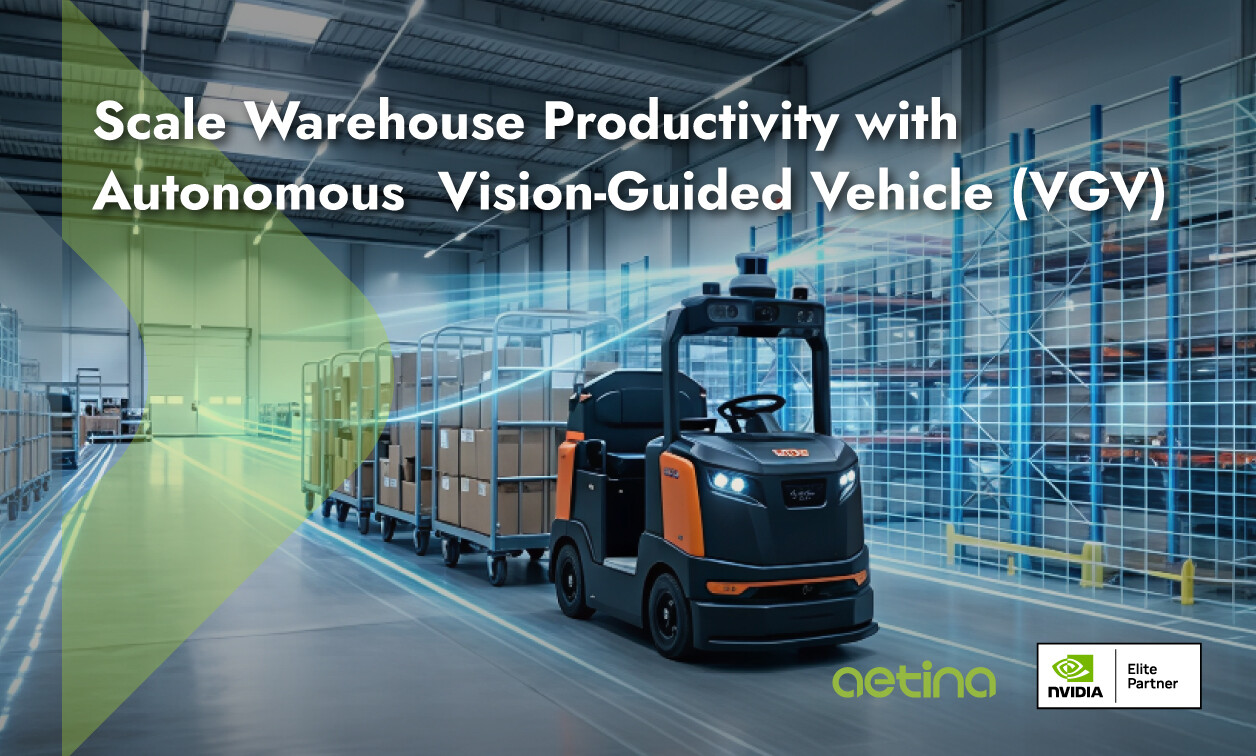
AI expertise and powerful embedded compute enable OEMs to meet industrial sector demand
Warehouse operations are overdue for digital reinvention. On top of industry-wide labor shortages, legacy material-handling techniques like conveyor belts and manual transport limit productivity and flexibility. It’s no surprise that analysts predict the global warehouse automation market will grow to over $119B by 2034, with the automated guided vehicle (AGV) market alone expected to see a CAGR of 11.4% between 2024 and 2033.
However, despite the demand and enthusiasm for warehouse automation solutions, practical challenges remain. The high capital expenditure costs and long installation timelines of modern infrastructure required for AGV and similar systems make it difficult to modernize or scale operations.
Vision-guided vehicles (VGVs) offer a promising solution to these pain points. They enable efficient, automated, 24/7 material handling. And unlike traditional AGVs, which rely on fixed navigation, VGVs can simply “perceive” their environment and “decide” where to go, making deployment faster and more cost-effective.
But advanced solutions are challenging to implement and VGVs are no exception. Their complex sensor fusion and autonomous decision-making workloads require powerful yet compact edge computing beyond the abilities of standard IPCs. And while OEMs and manufacturers see the need for VGVs, they often lack the in-house AI engineering resources to optimize off-the-shelf computing modules, complicating solution development and slowing time to market.
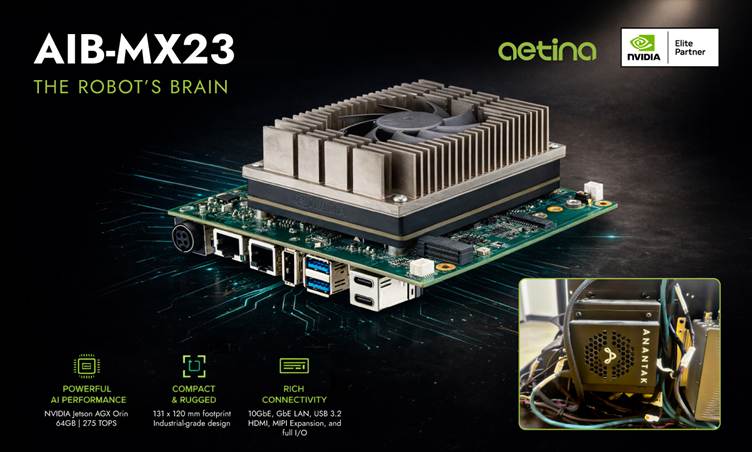
The good news is that modern embedded computing systems are helping product builders overcome these obstacles. The Aetina AIB-MX23 edge AI inference system, powered by the NVIDIA® Jetson AGX Orin™, is a good example. Packing up to 275 TOPS of AI computing power into a compact, rugged form factor, it is ideal for VGV and robotics use cases. The platform’s 64GB of unified LPDDR5 memory, with 204.8 GB/s memory bandwidth, delivers validated performance for running large foundation models and complex Al workloads at the edge. Together with support from experienced edge AI solution providers like Aetina, OEMs can now develop Industry 4.0 solutions faster than ever before.
From Concept to Mass Deployment: A VGV Case Study
Case in point is Aetina’s work with Anantak, a Texas-based provider of automated robotics systems for warehouse operations.
Anantak’s mission is to deliver practical, next-generation robotics solutions that solve the industrial sector’s most urgent needs. The company wanted to develop a VGV tugger system for material handling that collaborates with human beings—alleviating labor shortages and enabling round-the-clock operations.
The business case for a vision-based design was clear. It was more cost-effective and flexible than traditional AGV solutions that require built-in systems like tracks and rails, magnetic strips, and April Tags. VGVs help cut installation costs and timelines at warehouse locations, making it possible for manufacturers to scale up while lowering CapEx and OpEx.
However, these selling points can come with a cost: extensive compute demands and engineering complexity. To operate safely and effectively, VGVs rely on multiple sensor types:
- 2D LiDAR for obstacle detection
- 3D LiDAR for environmental mapping
- Multiple industrial depth cameras for vision-based localization and path planning
Computing platforms for VGVs must be powerful enough to handle complex AI algorithms and real-time sensor fusion workloads at the edge, while delivering sufficient I/O to support multi-sensor data streams.
Anantak also faced substantial engineering and design challenges, including:
- Compute, sensors, and hardware integration
- Tugger onboard software and AI algorithm optimization
Anantak found the partner it needed in Aetina. In 2022, the company placed initial batch orders for the Aetina AX720-X32, a computing platform based on NVIDIA Jetson AGX Xavier. Aetina engineers worked closely with Anantak throughout the development process with a successful prototype VGV unit being ready within the year. In 2025, Anantak decided to upgrade to the Aetina AIB-MX23 powered by NVIDIA Jetson AGX Orin—which delivers up to 275 TOPS of AI computing power—for a modernized, production-ready VGV solution.
The AIB-MX23 is the VGV's onboard “brain”: a single compute platform that ties together all sensing and actuation subsystems and handles multiple complex functions in real time, including:
Multimodal sensor fusion: AIB-MX23 integrates 2D LiDAR data to define obstacle safety zones, 3D LiDAR to feed a simultaneous localization and mapping (SLAM) pipeline for high-precision localization, as well as FRAMOS D455e camera data to support visual odometry and depth perception.
Autonomous navigation: Navigation algorithms, accelerated by NVIDIA CUDA and TensorRT, handle route planning, obstacle avoidance, and send steering and speed commands to the drive controllers.
Closed-loop correction: The navigation subsystem corrects positional drift by leveraging wheel encoder feedback as a continuous motion baseline. On the control side, a stability loop manages speed and turn radius to ensure that the tugger’s cart train moves smoothly and predictably.
Bidirectional connectivity: AIB-MX23 provides Wi-Fi and 10GbE links to central control systems, enabling per-unit tasking and route updates while streaming real-time telemetry from each tugger back to the control center to support coordinated fleet operation across approximately 200-unit deployments.
In terms of physical design, the computing platform is compact enough to integrate easily into the VGV without adding excessive weight or size, and rugged enough to withstand the dust and vibration of industrial settings. Plus, the AIB-MX23’s wide operating temperature range of -25°C – +80°C enables warehouse automation as well as many other embedded applications.
The Aetina and Anantak teams worked together to solve engineering challenges. Aetina designed and helped mount a custom case for the VGV compute module and customized the onboard AI software. In less than a year, Anantak had an updated, market-ready VGV solution.
The high reliability of the system ensures 24/7 autonomous operation at warehouse sites, significantly increasing material throughput while solving staffing bottlenecks and reducing labor costs. Operations are more efficient as well. The system reduces material-handling time by up to 80% compared to traditional methods.
Plus, the VGVs are quick to deploy. New locations can have a VGV system up and running in as little as two weeks, a vast improvement over the months typically required to install an AGV system.
Finally, these hardy tugger robots deliver tangible health and safety benefits to their human coworkers. With over 200 units now in deployment, manufacturing sites have seen a substantial reduction in workplace accidents and injuries since the VGVs began helping with material transport.
|
“The AIB-MX23 delivers the processing power we need in a compact, rugged package that can handle the harsh conditions of industrial facilities. The platform's ability to process multiple sensor streams simultaneously with low latency was essential for our real-time navigation requirements.” — Manuj Naman, CEO, Anantak |
The Benefits of Purpose-Built Robotics Platforms and Expert Engineering Support
Aetina’s work with Anantak shows how modern embedded AI computing platforms and engineering assistance can combine to bring high-performance products to market quickly and effectively.
The AIB-MX23 powered by NVIDIA Jetson AGX Orin makes an ideal platform for robotics development in the industrial edge:
|
Feature |
Details |
Benefits |
|
Compute |
NVIDIA Jetson AGX Orin 64GB: |
Delivers up to 275 TOPS of AI computing power—suitable for demanding computer vision and sensor fusion workloads at the edge. |
|
Memory |
64GB 256-bit LPDDR5 |
Ample memory bandwidth for high-throughput AI inference, vision processing, and sensor fusion workloads. |
|
I/O |
1 × 10GbE LAN port, 1 × GbE LAN port, 1 × 16-lane MIPI expansion connector, and 1 × USB 2.0 interface |
Rich I/O supports multiple high-bandwidth LiDAR sensors and industrial depth cameras for real-time perception. |
|
Dimensions |
131 × 120 × 63.9 mm (5.16 × 4.72 × 2.52 in) |
Compact form factor makes it easy to integrate into space-constrained robotics solutions. |
|
Temperature |
Operating range of -25°C - +80°C |
Reliable operation even in harsh environments. |
Beyond compute, Aetina's expertise and business relationships streamline solution development and enhance value for OEMs and their customers. As an NVIDIA Elite Partner, Aetina stays at the leading edge of the Jetson ecosystem, empowering the company to help product builders adapt NVIDIA technologies to their application requirements.
In addition, as Anantak can attest, Aetina’s technical teams can help with all aspects of solution development, from foundational software engineering like stack customization and performance optimization to hands-on physical integration and purpose-built enclosures.
|
Aetina's continuous support and expertise in Jetson-based systems were extremely valuable and helped to significantly accelerate our development timeline. — Josh Hernandez, Senior Engineer, Anantak |
Eliminating Barriers to Market-Ready Solutions
The industrial sector is hungry for innovative robotics solutions that transform operations in warehouses, on the shop floor, and beyond. And although the market is ready, until recently, solutions developers were not.
The good news for everyone is that innovations in the robotics and AI ecosystems are sweeping away old obstacles such as insufficient compute and intractable engineering problems. Solution-ready embedded AI platforms like AIB-MX23 powered by NVIDIA Jetson AGX Orin deliver the power and the reliability needed to deploy mission-critical robotics systems at the edge. A mature NVIDIA software ecosystem, based on foundational frameworks like NVIDIA® CUDA® and TensorRT™, makes it simpler to develop practical AI-enabled systems. And with support from edge AI solution specialists like Aetina, OEMs no longer have to go it alone. Instead, they’re able to solve their toughest development challenges with the help of a trusted partner.
Robotics and AI are fast-moving fields. NVIDIA and Aetina continue to keep pace, delivering cutting-edge capabilities to their ecosystem partners. Anantak, for example, is already evaluating Aetina’s next-generation platforms
CTA: Connect with Aetina’s engineering team today to discuss a custom robotics project or use case powered by NVIDIA Jetson Thor, AGX Orin, Orin NX, and Orin Nano.