
How AI is Changing the Way We Do Business
October 09, 2025
Blog
We’re experiencing a rapid shift toward IT applications that include AI. This represents the first stage of unprecedented transformation in the way corporations of all sizes do business.
The business world is built on a legacy of information technology (IT), reaching back decades to the earliest mainframe computers. Artificial intelligence (AI) is challenging that continuum by introducing a step change in capabilities. The opportunity presented is putting very real demands on our relationship with technology.
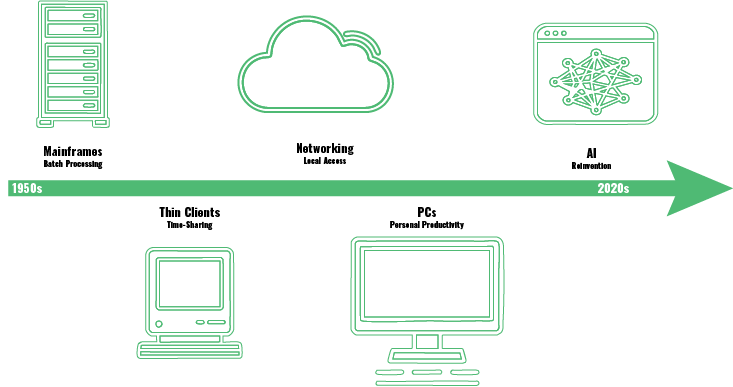
Applying AI to business activities is the latest in a long line of technological advancements. For years, those advancements have been largely invisible. Indeed, the companies behind the advancements have worked hard to make the changes as transparent as possible. There is comfort in the familiar, and dangers associated with change without consideration.
Companies looking to introduce AI into their workflows must respect this, particularly if those workflows are people-oriented. An international distribution business, such as Avnet, is a good example. Our people are our company.
But we also rely on IT, and the simple truth is that AI and IT are now on a parallel path that will likely merge into something new. Avnet has a roadmap for integrating AI into its business systems and has established an AI Governance Framework that includes a governance council focused on data privacy and ethical principles. Working closely with all stakeholders will be essential to making the journey successful. Change management at this level may be unprecedented; it is not insurmountable.
AI in the Supply Chain
Technology companies need to understand that the bar is always rising, as consumers recognize how fast technology moves. We need only look at the ascendence of streaming platforms over non-volatile storage like VHS tapes and DVDs to appreciate how quickly the delivery can change, while the content stays largely the same.
We could apply the same optics to component distribution. The components (although always evolving) represent a constant, while the way we source, supply, and support those components is constantly evolving.
This description is also analogous to business systems as a whole. The technology (software, applications) may be on a path of continuous integration/continuous delivery (CI/CD), but the user experience remains constant. The user doesn’t need to change their own working habits to benefit from performance gains.
The same should be true of AI, at least initially. We should be using the inherent gains AI offers to benefit our employees and our customers, without presenting a steep learning curve. This is the challenge that all businesses now face. There needs to be a commitment to change management and talent enablement, through training and upskilling employees, while fostering a culture of innovation that will help AI adoption.
The temptation is to move quickly – as fast as the technology providers would allow – to integrate AI into every process. That may be the destination, but the journey has many important waypoints.
AI as a Force Multiplier
We can already see how AI integration is impacting the IT tools we use all day, every day. Businesses rely on the expertise of their people, using these tools, to provide a personalized service. Component distribution is a large part of our business, and it has many interdependent processes, from quoting to delivery. We use specialist software alongside standard office applications to provide that service, and there has been continuity in how those tools have evolved.
|
How AI will be used |
Functions AI will perform |
Benefits of using AI |
|
Automation and autonomous operations |
Automation of complex decisions, such as inventory allocation, demand forecasting, and production planning |
Allows supply chain experts to focus on strategic and exceptional challenges |
|
Real-time analytics |
Processing large amounts of data to detect anomalies |
Reroute shipments or adjust inventory to reduce delays, lower costs, and improve fulfillment |
|
Predictive and prescriptive analytics |
Suggest optimal actions, not just outcomes |
Allows supply chain operatives to proactively mitigate risk and manage disruption |
|
Digital twins and simulation models |
Continuously simulate and optimize physical supply chains |
Use models for scenario testing and adjustments to operations |
|
Generative AI applications |
Models will help supply networks, forecast demand for new products, and simulate rare events |
Optimize network design using synthetic data to generate operational plans |
|
Route planning |
Dynamically optimize delivery routes |
Help operatives optimize for speed, efficiency, and environmental goals |
|
Sustainability |
Optimize energy use, reduce waste, and monitor environmental compliance |
Help supply chain companies meet sustainability goals |
|
Risk management and resilience |
Anticipate and mitigate supply chain disruptions |
Improve response times and overall resiliency. Control towers will monitor worldwide activity |
The introduction of AI at this level should provide an ‘out-of-the-box’ boost to productivity, without forcing users to adapt the way they work. The suppliers of these tools are on a similar journey of transformation. While AI will be used at every stage of the supply chain service in the future, the immediate gains come from allowing our skilled operatives access to AI-enhanced versions of the tools they already know and use.
Searching documents for information, summarizing that information, and drafting a report that provides insights for customers are all tasks we carry out today that could be augmented using AI. In the near future, our customers will be able to have greater access to insights generated using the same data that drives our business.
Business processes are built on automation and data. Adding AI into the business should be a natural evolution. Using AI to improve the way data is handled automatically will happen in two crucial ways. First, AI will be used to gather and pre-assess the data that already feeds existing automation tools. Second, the output of those tools, which people currently use, will be used by AI agents that deliver faster results.
The digital workplace is evolving, and employers should take steps to make the transition as productive as possible. Making AI accessible to employees will enable them to create solutions that will benefit customers for years to come.
Max Chan is the Chief Information Officer (CIO) at Avnet. With a deep understanding of the latest digital trends and technologies, he leads all aspects of information technology (IT), including cybersecurity, digital strategy, and transformations that position Avnet as a digital-first organization. Chan oversees the resources and capabilities of the global IT team, ensuring the organization maintains a robust and optimized IT environment.

Max Chan is the Chief Information Officer (CIO) at Avnet. With a deep understanding of the latest digital trends and technologies, he leads all aspects of information technology (IT), including cybersecurity, digital strategy, and transformations that position Avnet as a digital-first organization. Chan oversees the resources and capabilities of the global IT team, ensuring the organization maintains a robust and optimized IT environment.