Advantech Teams With AMD To Maximize Performance at the Edge
December 08, 2025
Blog

High-performance computing at the Edge involves systems that bring server-class processing closer to where data is generated. Instead of sending private information to the Cloud, devices at the network’s Edge, gateways, sensors, industrial controllers, cameras, and embedded AI platforms, run complex workloads locally. This is beneficial for applications like medical imaging, Edge servers, networking, and enterprise-level LLM (Large Language Model) deployment, and includes markets such as healthcare, industrial automation, smart cities, robotics, automotive, and advanced consumer devices. Its growth is driven by tighter latency requirements, rising data volumes, stronger privacy demands, and the need for more efficient, scalable distributed compute architectures.
Building on that trend, the Edge is increasingly demanding higher performing compute engines, specifically high-core-count CPUs, high-end GPUs, and FPGA-based accelerators. As workloads shift from simple control tasks to dense AI inference, multi-sensor fusion, advanced vision pipelines, and near–real-time decision loops, traditional embedded processors can’t keep up. High-core CPUs provide the parallelism needed for complex software stacks, while GPUs deliver massive throughput for neural networks and image processing.
Staying in line with this trend, Advantech is centering its next-generation Edge platforms on the AMD EPYC™ Embedded series of embedded processors, which provides the muscle needed for these increasingly demanding workloads. EPYC™ Embedded processors offer high core counts, large memory footprints, extensive PCIe connectivity, and strong power-efficiency. They bring data-center architecture into ruggedized, long-lifecycle embedded platforms, giving Advantech the flexibility to scale from compact edge servers to multi-accelerator industrial AI nodes. By using EPYC™ Embedded as the compute foundation, Advantech can deliver solutions that meet the rising requirements of real-time AI, advanced vision, and secure, distributed Edge computing.
Looking at specific applications, modern medical imaging pushes Edge systems to their limits. Modalities like MRI, CT, and ultrasound generate massive, continuous data streams that must be processed instantly to maintain image fidelity. The sheer throughput challenges even high-end embedded computers, especially as resolutions, frame rates, and 3D reconstruction requirements rise. At the same time, precise calibration is essential, i.e., every sensor, beam source, and reconstruction algorithm must remain tightly aligned to produce diagnostically reliable results. Adding to this complexity, patient anatomy and conditions vary widely, requiring adaptable, real-time processing pipelines that preserve accuracy across cases. These demands make precision, performance, and deterministic data handling absolutely critical.

Different medical imaging specialties push Edge compute in distinct ways. For example, optical coherence tomography (OCT) systems demand ultra-high-resolution processing at extremely high line rates, requiring deterministic pipelines that can handle gigabytes per second while preserving micrometer-level accuracy. Ultrasound systems need low-latency beamforming, real-time Doppler analysis, and the ability to run advanced AI algorithms on streaming data without interrupting a clinician’s workflow.
Surgical simulation raises a different challenge: it must render photorealistic, physics-accurate environments at high frame rates while dynamically adapting to a user’s interactions. Across all three, the requirements converge on exceptional throughput, tight timing, and compute architectures capable of sustaining both precision and immediacy.
To meet these requirements, the medical imaging and advanced Edge computing space is undergoing a significant transition. Traditional embedded motherboards, while reliable and compact, often relied on modest CPUs and limited memory bandwidth, constraining performance for high-resolution imaging and real-time AI inference. Today, the shift is toward boards with high-bandwidth memory, multi-core processors, and extensive I/O connectivity, enabling parallel processing of massive data streams. This evolution allows imaging systems to deliver higher accuracy, faster reconstruction, and more responsive visualization, while supporting GPU and FPGA acceleration for AI-driven enhancements. In essence, Edge platforms are evolving from simple control boards into full-fledged, data-center-class compute nodes tailored for precision-critical applications.

Thankfully, and as evidenced by Advantech, the Edge computing and networking space is experiencing major gains, moving from traditional embedded boards to high-bandwidth, multi-core platforms. This has a lot to do with the need for flexible functionality and high data bandwidth in networking and server deployments, which current COM express systems can’t fully support due to pin limitations and performance constraints In addition, those legacy boards, while compact and reliable, often lacked the throughput and parallelism needed for real-time analytics, AI inference, and large-scale data handling.
Modular COM-HPC designs let clients scale performance by mixing and matching compute modules, including a CPU, GPU, memory, and I/O, much like assembling a puzzle. They can upgrade processing power or add accelerators without redesigning their entire systems. In contrast, industrial motherboards offer a fully integrated, plug-and-play platform with all major features baked in, enabling fast deployment and predictable performance. Together, these approaches let developers choose between fine-grained customization or ready-to-use robustness, depending on project needs.
Running AI Workloads Closer To the Source

Another rapidly expanding market involves enterprise AI and LLMs (large language models), driven by the need to run large-scale AI workloads closer to users and data sources. Instead of relying solely on the Cloud, enterprises are deploying Edge servers to handle real-time inference, context-sensitive processing, and secure data handling with minimal latency. These workloads also demand high-core-count CPUs, high-end GPUs, and FPGA or AI accelerators to efficiently process massive model parameters and embeddings, while supporting parallel, memory-intensive operations required by LLMs and generative AI.
Advantech addresses this trend by building next-generation Edge servers around the AMD EPYC™ Embedded processors, with an architecture that enables enterprises to deploy LLMs locally. The result is support for inferencing at scale while maintaining performance, power efficiency, and long lifecycle reliability. In this scenario, diverse data types, including text, images, and structured records, necessitate flexible pipelines capable of handling concurrent tasks efficiently.
For enterprise LLM and AI workloads at the edge, Advantech’s AIR-540 workstation (part of its AIR-500 series) delivers a powerful, compact platform optimized for in-house large model tasks. Built on an AMD EPYC™ Embedded 8004 series CPU with up to four dual-slot GPUs, it supports both model fine-tuning and inference. Its tight integration with Advantech’s GenAI Studio enables secure, on-prem LLM customization, empowering enterprises to train and deploy models with minimal latency and without relying on the Cloud.
And because all training data, model updates, and inference queries stay local, security is significantly strengthened; sensitive IP, customer data, and operational insights never leave the premises. This eliminates exposure to third-party Cloud environments and gives enterprises tighter control over privacy, compliance, and governance.
The Advantech software stack further strengthens the platform’s value. For example, the bundled GenAI Studio provides tools for post-training optimization, synthetic and augmented dataset generation, and rigorous model validation, making it easier for enterprises to refine, test, and confidently deploy tailored LLMs at the edge.
The Micro-ATX Motherboard
Powered by an AMD EPYC™ Embedded 8004 CPU (up to 64 cores), the AIMB-593 Micro-ATX motherboard supports up to 576 Gbytes of DDR5 ECC RDIMM, delivering massive memory bandwidth to minimize CPU bottlenecks. It offers four PCIe Gen5 by-16 slots, plus two MCIO 8i connectors for a daughterboard, adding two more full-speed PCIe lanes, enabling up to six high-bandwidth expansion cards. It can be integrated into space-constrained systems (e.g., medical workstations or Edge servers) without sacrificing performance. This design is ideal for highly parallel compute workloads, such as AI inference or multi-GPU acceleration, providing enterprise-grade throughput in a modular, deployable footprint.
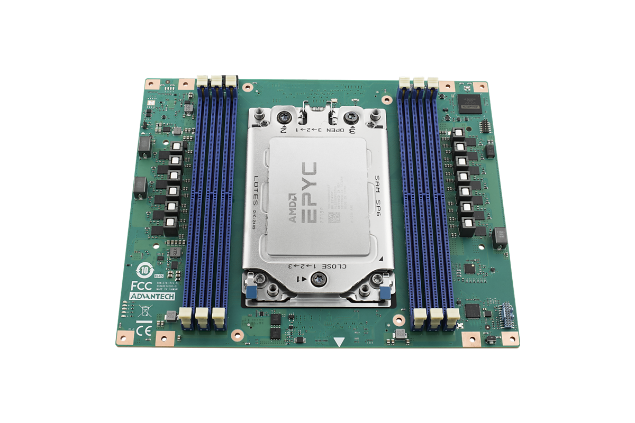
The Advantech SOM‑E781 COM‑HPC extension module stands out by supporting a server-grade AMD EPYC™ Embedded 8004 CPU with up to 64 cores, a TDP around 200 W, and as much as 576 Gbytes of DDR5 memory. Thanks to an optimized, proprietary pinout, the extension module delivers 79 total PCIe Gen5 lanes (vs. 64 on standard COM‑HPC), enabling flexible expansion via graphics cards, NICs, storage, or accelerators, and even CXL 1.1 memory sharing. In addition, multiple SOM‑E781 modules can be deployed on a single carrier board, giving system designers strong scalability for Edge servers, networking, or virtualization-heavy workloads. This makes it uniquely powerful—to date, it’s the only COM‑HPC module offering this level of integration with the EPYC™ Embedded 8004 platform.
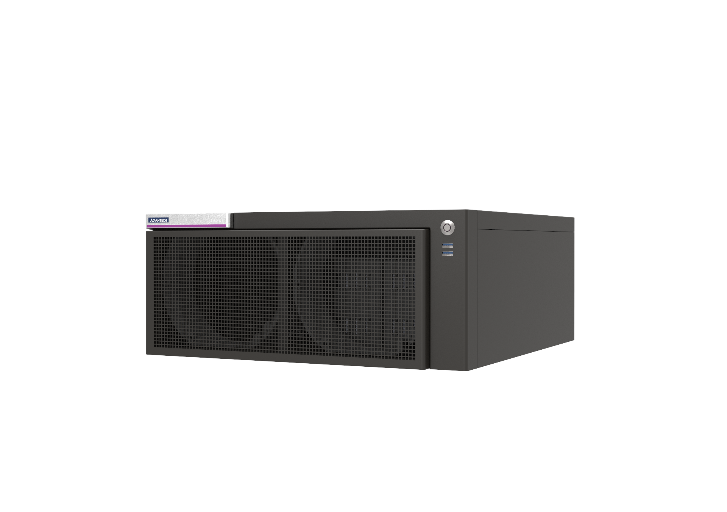
Also in the company’s arsenal, as discussed briefly above, is the AIR-540 Edge AI workstation, which combines a compact, server-grade design with support for up to four mainstream GPUs, enabling on-premise fine-tuning and deployment of large open-source LLMs. Its efficient power and thermal design minimize noise and eliminate the need for specialized cooling infrastructure, making it suitable for office or lab environments. The system balances high compute density with practicality, offering enterprises a ready-to-use platform for AI workloads that require substantial parallel processing while maintaining manageable power and acoustic profiles.
A Plethora of Software Support
Advantech’s Edge AI and embedded systems are delivered with extensive software support to streamline deployment and integration. All systems are pre-validated for Windows Server, Windows 11 LTSC, and Linux (Ubuntu), ensuring compatibility and rapid installation. These OS choices are tested for robustness and comply with IEC 60068 environmental standards, supporting reliable operation in demanding edge or industrial environments.
Advantech provides software development kits (SDKs) tailored for specific workloads. The Edge AI SDK enables model deployment, post-training optimization, dataset generation, and performance validation for accelerated edge AI development. Robotics SDKs simplify integration with automation platforms, while device management SDKs allow standardized control over system resources.
For multi-node or remote deployments, the company’s DeviceOn management platform offers centralized monitoring, automated maintenance alerts, and remote firmware updates, reducing operational overhead and minimizing downtime. Collectively, this software ecosystem ensures that enterprises can quickly deploy high-performance computing platforms for AI, medical imaging, LLM fine-tuning, and virtualization while maintaining security, reliability, and ease of maintenance across both single-site and distributed edge environments.
Summary
Advantech is uniquely positioned at the forefront of high-performance Edge computing, combining AMD’s server-grade processors, comprehensive Edge AI services, and FPGA expertise to deliver solutions that are both powerful and adaptable. Through standardized, modular designs, robust software ecosystems, and scalable hardware, Advantech enables enterprises to reliably and securely meet the demands of complex AI, networking, and industrial workloads.
Looking ahead, the company remains committed to advancing Edge computing technologies that address the evolving needs of its customers and the market. As a leading supplier of high-performance, scalable, and secure Edge AI platforms, Advantech empowers organizations to innovate with confidence. Guided by its vision, the company continues to support customers in building the next generation of intelligent, data-driven solutions, transforming ideas into practical, high-impact applications at the edge.
Choose Advantech
Advantech stands out amongst its peers thanks to over 40 years of experience in embedded computing design, delivering innovative and reliable solutions. Its products undergo a robust design and validation process, ensuring long-term reliability and full lifecycle traceability.
Advantech’s customers benefit from a comprehensive hardware and software ecosystem, ranging from individual boards to complete systems, along with firmware, security protections, peripherals such as memory, SSDs, wireless modules, displays, and supporting SDKs. The company also offers thermal optimization and design services, providing expert guidance for long-term stability in industrial environments.
A global manufacturing footprint ensures stable supply and flexible production capacity, while worldwide technical and sales support across 12 countries guarantees responsive service. Contact the company today to learn more.

Rich Nass is a regular contributor to Embedded Computing Design. He has appeared on more than 500 episodes of the popular Embedded Executive podcast series, and is a regular contributor to the Embedded Insiders podcast.
Rich has been in the engineering OEM industry for more than 35 years, and is a recognized expert in the areas of embedded computing, Edge AI, industrial computing, the IoT, and cyber-resiliency and safety and security issues. He writes and speaks regularly on these topics and more.
Rich is currently the Liaison to Industry for the Embedded World North America Exhibition and Conference, and has held similar positions with the global Embedded World Conference and Exhibition.
Previously, Rich was the Brand Director for UBM’s award-winning Design News property. Prior to that, he led the content team for UBM Canon’s Medical Devices Group, as well all custom properties and events. In prior stints, he led the Content Team at EE Times, handling the Embedded and Custom groups and the TechOnline DesignLine network of design engineering web sites.
Nass holds a BSEE degree from the New Jersey Institute of Technology.
Podcast/Interview Coverage
IEEE Awards Frede Blaabjerg Talks EVS
Atmosic: Embedded Executive: Energy Harvesting Podcast
Article Coverage
Embedded AI Isn’t Enterprise AI, and That’s a Good Thing
Tear Down: Google Pixel Watch 4
Protect Your Home from Thieves and Floods
Advantech Teams With AMD To Maximize Performance at the Edge
View additional information