Edge AI and Data Proliferation Place New Demands on Embedded Platforms
August 06, 2025
Sponsored Blog
The embedded computing industry is at a pivotal moment, facing a new wave of workload complexity and infrastructure challenges driven by the rapid rise of AI-driven applications at the edge and the demands of relentless data growth. As digital transformation accelerates across sectors, embedded platforms must adapt to support next-generation requirements across networking, storage, and edge applications. These challenges are redefining performance expectations and creating pressure for embedded computing systems to deliver more — not just in raw compute performance but in connectivity, scalability, and long-term deployment.
AI Workloads Driving Unprecedented Demands on Network Performance
One of the most pressing challenges is the accelerated rise of AI-driven applications, which is fundamentally reshaping network data flows. From intelligent edge inference to secure, encrypted communications, modern workloads are generating and consuming data at unprecedented rates. This surge in traffic is pushing embedded platforms to deliver significantly higher throughput, lower latency, and greater packet processing efficiency. Legacy compute platforms are quickly reaching their limits, especially as real-time responsiveness becomes a baseline expectation. Addressing this challenge requires compute solutions that can keep pace with complex, high-bandwidth traffic while maintaining power and thermal efficiency for deployment in constrained environments.
Data Explosion Driving Storage Requirements
Simultaneously, the industry is grappling with the relentless explosion of data, spanning both structured and unstructured formats. Embedded systems are increasingly expected to do more than just store information—they must now analyze, optimize, and manage data flows in real time. This shift is especially pronounced in environments where real-time responsiveness is mission-critical, and cloud offloading is impractical. As a result, modern storage subsystems require not only expanded capacity, but also advanced data services such as inline compression, deduplication, and analytics acceleration. Meeting these requirements demands embedded platforms with higher I/O bandwidth, improved data path efficiency, and scalable compute resources that can process data where it is generated.
Rising Compute Demands at the Industrial Edge
At the same time, the industrial edge is becoming a new frontier for high-performance embedded computing. Sectors such as manufacturing, energy, healthcare, and transportation are deploying increasingly intelligent systems that rely on real-time data processing for automation, anomaly detection, and predictive maintenance. These edge environments produce massive volumes of sensor and machine data that are typically processed locally, often under strict latency and reliability constraints. This challenge calls for embedded solutions that deliver consistent, low-latency performance in rugged, power-constrained environments, while also offering long lifecycle availability and long-term platform stability.
Taken together, these challenges highlight a clear and growing need for next-generation embedded computing platforms that can deliver high-performance compute, flexible I/O, and durability while staying optimized for the unique constraints of embedded and industrial environments.
AMD EPYC Embedded – Rising to Meet the Challenge
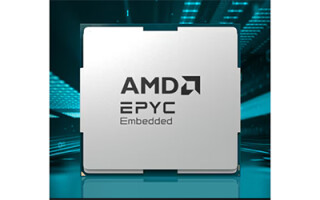
“AMD EPYC Embedded 9005 Series of processors are in production today and are specifically tailored to address these challenges,” said Tarang Shah, product manager for the AMD EPYC Embedded product line, adding that particular attention was paid to reaching new efficiency benchmarks—without sacrificing processing performance.
Shah said, “AMD EPYC Embedded 9005 Series CPUs are highly efficient, delivering an estimated 15-30 percent performance uplift over the previous generation.” (EEB-009) The processors scale from 8 to 192 “Zen 5” cores in a single socket, allowing developers to select the optimal level of performance for the application. With AMD EPYC Embedded CPUs, developers can deliver platforms that scale, while minimizing platform and software stack changes.
“The strength of this new product line is that it delivers a confluence of rich, purpose-built embedded features, compute performance, scalability, and efficiency—enabling customers to design high-performance, reliable, and long-lasting systems,” Shah said. “AMD EPYC Embedded 9005 Series processors offer the level of performance that modern applications require, with exceptional energy efficiency. And the applications are wide and varied, thanks to the efficient and powerful design.”
Performance and Power – Without Sacrifice
AMD EPYC Embedded 9005 Series processors can deliver up to a 1.3X improvement in networking throughput (EEB-002), and a 1.6X increase in data processing throughput for storage workloads (EEB-001), so network and security firewall platforms, storage systems, and industrial control applications are a natural fit. This high throughput also comes with leadership energy efficiency. AMD states that users will find an estimated 1.3X increase in socket throughput (EEB-005) and an estimated 1.3X performance per watt boost (EEB-010), as compared to the competition. Meanwhile, the family supports memory capacities of up to 6 TB of DDR5 memory per socket, and expanded I/O connectivity, while supporting up to 160 PCIe Gen5 lanes with CXL 2.0 in a dual socket configuration.
“Beyond performance and power, there are other metrics, such as product longevity, reliability, and system resiliency, that are essential for embedded deployments,” Shah said. To address these needs, AMD EPYC Embedded 9005 Series processors offer a unique set of features tailored for demanding environments. The processors support up to a 7-year manufacturing lifecycle, helping reduce the need for frequent redesigns and safeguard customer investments. Additionally, select SKUs are optimized for extended 7-year design operation, providing a stable and reliable foundation for long-term deployments.
To enhance system resiliency, the AMD EPYC Embedded 9005 Series supports advanced features such as non-transparent bridge (NTB) and DRAM flush. NTB enables fault-tolerant, high-availability, multi-host configuration, enabling maximum system uptime, while DRAM flush helps safeguard critical data by transferring data from volatile to nonvolatile memory during power loss.
AMD EPYC Embedded 9005 Series also supports a dual serial peripheral interface (dual SPI), enabling customers to integrate proprietary bootloaders for secure, authenticated platform startup.
“Platform authentication establishes a trusted execution environment, forming a critical layer in the end-to-end security of embedded systems,” said Shah.
Get Started Today
AMD EPYC Embedded 9005 Series processors leverage socket SP5, compatible with prior-generation AMD EPYC Embedded 9004 Series CPUs, providing an upgrade path to customers (9XX5-048). You can migrate today without spinning a new hardware platform.
Whether you’re already leveraging AMD EPYC Embedded CPUs and “Zen” architecture or considering a transition from a competing AMD platform, the AMD EPYC Embedded 9005 Series is designed to deliver the performance and reliability your next platform demands. Check it out now.

Ken Briodagh is a writer and editor with two decades of experience under his belt. He is in love with technology and if he had his druthers, he would beta test everything from shoe phones to flying cars.
At Embedded Computing Design, he covers, AI, Edge Computing, Data Centers, Automotive, Industrial, Smart City, IoT and IIoT, Semiconductors, Healthcare, and lots more. He hosts weekly programs on YouTube, including the technology unboxing feature DevKit Weekly, and his news show ICYMI, and, along with Tiera Oliver, hosts the Embedded Insiders and Embedded Executive podcasts.
In previous lives, he’s been a short order cook, telemarketer, medical supply technician, mover of the bodies at a funeral home, pirate, poet, partial alliterist, parent, partner and pretender to various thrones. Most of his exploits are either exaggerated or blatantly false.
Muck Rack: https://muckrack.com/ken-briodagh
Industry Moderator: https://www.microelectronicsus.com/speakers/ken-briodagh-1
Apple Podcasts: https://podcasts.apple.com/us/podcast/embedded-insiders/id1359230366
Spotify: https://open.spotify.com/show/5X07QpW7U2CM9ZbGxl4p40