Why In-Domain ASR Is the Missing Link for Real Edge AI Deployment
April 10, 2026
Blog

Over the past two years, artificial intelligence (AI) has been defined by the rise of large language models (LLMs). Systems like ChatGPT have reshaped expectations around conversational interfaces and reasoning. Yet when we move beyond demos and examine what is shipping in consumer and industrial products, the presence of AI at the edge remains surprisingly limited.
This gap is not caused by a lack of innovation. Rather, it is the result of a fundamental mismatch between how “big AI” is conceived and what edge AI requires.
Big AI Thinking vs. Edge AI Reality
Much of today’s AI development starts in the cloud. Models are trained at a massive scale, then aggressively optimized, compressed, quantized, and pruned in an attempt to squeeze them into battery-powered devices. The underlying assumption is that intelligence must be built big first and reduced later. While this approach occasionally works, it does not scale.
Edge AI requires a different mindset. Instead of asking how we fit cloud AI into a small device, the more productive question is how we build intelligence from the ground up within edge constraints. Power, memory, latency, thermal limits, offline operation, and cost are not secondary concerns at the edge. They are first-order design inputs. As a result, small language models (SLMs) and domain-specific intelligence have become essential elements of on-device edge AI.
The Voice Interface Bottleneck
Voice should be one of the most natural interfaces for edge AI. It is hands-free, intuitive, and well-suited for wearables, appliances, vehicles, and industrial devices. In practice, however, voice features often fail in production. The root cause is not weak downstream AI but unreliable automatic speech recognition (ASR).
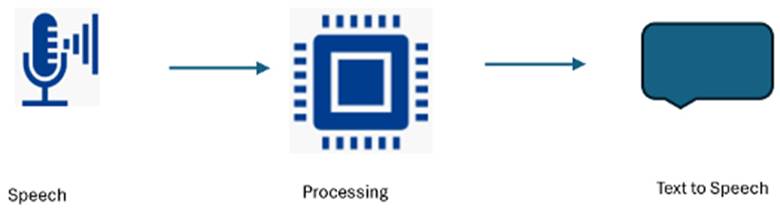
Figure 1: ASR converts spoken words into text, enabling machines to understand human speech.
Modern state-of-the-art ASR performs exceptionally well on general speech. Dictation, captions, and casual queries routinely achieve word error rates in the low single digits. But once domain-specific language enters the conversation, such as product names, technical terms, alphanumeric identifiers, or industry jargon, accuracy drops sharply.
In real deployments, it is common to see error rates jump from 2-4% to well above 10%. At that point, voice interaction becomes frustrating rather than helpful, and users abandon it entirely.
Why General ASR Does Not Scale at the Edge
The typical response to such drops in accuracy is to adapt or retrain the model. However, this approach breaks down quickly in practice.
Traditional domain adaptation depends on large volumes of labeled audio data for every new domain, product, or customer. Collecting this data is expensive, slow, and often impractical. Worse, the most valuable training data comes from real users, but real usage cannot be collected until the system already works. This creates a chicken-and-egg problem that stalls many voice projects.
Shortcuts such as hot‑word boosting or post-processing word replacement provide limited relief. They bias recognition, but do not teach the model how new words actually sound. If the acoustic representation does not exist, no amount of tuning can fix the problem reliably. As a result, many teams conclude that voice is not ready for their application, when the real issue is that the ASR was never designed for the domain.
The Hidden Constraint Holding Back Edge LLMs
This limitation becomes even more critical in the context of LLMs at the edge. LLMs are often positioned as the future of voice interaction, but they are only as effective as their inputs. If the ASR output is incorrect, even the most capable language model cannot reliably recover user intent.
This is one reason we see far more LLM demonstrations than real edge deployments. Models remain cloud-dependent, latency and privacy concerns persist, and the speech input pipeline is fragile. In other words, edge LLM adoption is not blocked by a lack of intelligence. It is blocked by unreliable speech recognition.
In‑Domain ASR: An Edge‑First Approach
In-domain ASR takes a fundamentally different approach. Instead of building a single general-purpose model and hoping it works everywhere, it starts with the language of the application itself.
Most products already define their vocabulary in text. Command lists, UI labels, product documentation, error messages, and technical terminology already exist. In‑domain ASR leverages this existing knowledge directly, enabling speech recognition to be customized without massive audio datasets or prolonged retraining cycles.
This aligns naturally with edge AI thinking. The model is small, focused, and purpose-built. Accuracy is concentrated where it matters, rather than diluted across every possible use case.
Domain-Specific ASR as an SLM
From an architectural perspective, in‑domain ASR is effectively a specialized SLM. It is not trying to understand everything. It is trying to understand the right things extremely well.
Because the scope is constrained, these models remain compact, efficient, and predictable. They run locally, meet real-time latency requirements, and operate without cloud connectivity. Power consumption is controlled, privacy is preserved, and system behavior is easier to validate.
Most importantly, once ASR becomes reliable, downstream intelligence—whether rule-based logic, classical NLU, or lightweight language models—can finally deliver consistent value.
Turning Edge AI from Hype into Utility
The industry does not need to force cloud-scale AI into edge devices to make progress. It needs edge intelligence designed from the outset to respect constraints.
In-domain ASR demonstrates how this shift works in practice. By abandoning the assumption that bigger is better and embracing domain-specific SLMs, developers can unlock real, productive edge AI applications, from wearables that understand training metrics to devices fluent in technical and local terminology.
If edge AI is going to move beyond experimentation and into everyday products, it will not start by thinking bigger. It will start by thinking smarter and by listening better.
For more information on how in-domain ASR models paired with audio DSPs can overcome the fundamental limitations of domain-specific language and deliver a superior voice user experience, read this related white paper: In-Domain Automatic Speech Recognition: Enhancing Accuracy and Efficiency.

Casey Ng leads audio digital signal processing marketing at Cadence, working with global audio DSP partners across consumer, professional, and automotive markets. A co founder of Nuforce and former CTO of Erato Wireless, he has delivered over 50 award winning audio products and holds multiple acoustics patents.