Flexible Conductive Film Boasts High Transparency, Low Resistance
March 24, 2026
Blog
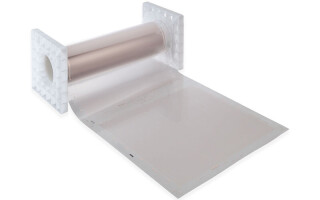
Panasonic Industry recently introduced a transparent conductive film called FineX FineCross) designed for EMI shielding in applications where optical clarity must be maintained. The film targets systems such as displays, industrial equipment interfaces, and wireless communication environments where both visibility and electromagnetic control are required.
FineX is based on Panasonic’s copper metal-mesh microfabrication process, which creates a fine, uniform wiring structure embedded in the film. The mesh provides electrical conductivity while maintaining high optical transmission, allowing the material to function as a shielding layer without significantly obstructing visibility. The film is supplied in roll form with a pre-applied optical clear adhesive, allowing it to be laminated directly onto glass or other transparent surfaces during manufacturing.
The copper mesh structure is designed to provide low electrical resistance while remaining visually unobtrusive. This combination allows the film to support functions such as EMI shielding and, in some cases, uniform heating when current is applied. The mesh pattern can also be customized to accommodate different design requirements for electromagnetic control while minimizing visual diffraction effects. Because the material is based on a thin film structure with fine wiring, it can be applied to curved or non-flat surfaces as well as conventional flat panels. The roll format and integrated adhesive are intended to simplify handling and reduce lamination steps during assembly.
Potential applications include transparent EMI shielding for displays, touchscreens, and glass-based human-machine interfaces, as well as shielding windows and control panels on industrial equipment. The material may also be used in wireless environments where localized control of radio frequency propagation is required, such as in RFID systems or installations that must manage interference among multiple wireless technologies.

Rich Nass is a regular contributor to Embedded Computing Design. He has appeared on more than 500 episodes of the popular Embedded Executive podcast series, and is a regular contributor to the Embedded Insiders podcast.
Rich has been in the engineering OEM industry for more than 35 years, and is a recognized expert in the areas of embedded computing, Edge AI, industrial computing, the IoT, and cyber-resiliency and safety and security issues. He writes and speaks regularly on these topics and more.
Rich is currently the Liaison to Industry for the Embedded World North America Exhibition and Conference, and has held similar positions with the global Embedded World Conference and Exhibition.
Previously, Rich was the Brand Director for UBM’s award-winning Design News property. Prior to that, he led the content team for UBM Canon’s Medical Devices Group, as well all custom properties and events. In prior stints, he led the Content Team at EE Times, handling the Embedded and Custom groups and the TechOnline DesignLine network of design engineering web sites.
Nass holds a BSEE degree from the New Jersey Institute of Technology.
Podcast/Interview Coverage
IEEE Awards Frede Blaabjerg Talks EVS
Atmosic: Embedded Executive: Energy Harvesting Podcast
Article Coverage
Embedded AI Isn’t Enterprise AI, and That’s a Good Thing
Tear Down: Google Pixel Watch 4
Protect Your Home from Thieves and Floods
Advantech Teams With AMD To Maximize Performance at the Edge
View additional information